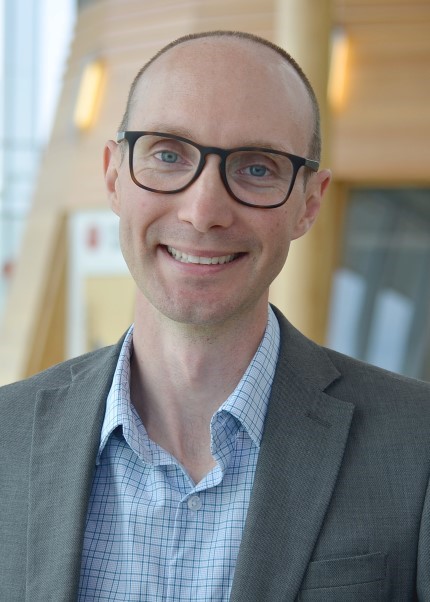
Tyler Finley

(He, Him, His)

Communications Manager

Engineering
Office: EME4241
Email: tyler.finley@ubc.ca


MDes students learning outside

The MDes program learning in Woodhaven Regional Park.

UBC Okanagan’s Master of Design (MDes) professional graduate program recently welcomed its inaugural cohort of students.

Rooted in critical design thinking, creative practice and design principles, the program—collaboratively delivered by the School of Engineering (SoE) and Faculty of Creative and Critical Studies (FCCS)—empowers students to tackle real-world challenges alongside industry, community and public sector partners.

In this blog series, Professor Dr. Kenneth Chau and the MDes Team reflect on the cohort’s journey as they work together to solve pressing societal problems and embrace new ways of learning, teaching and innovating.

MDes: One Month In

Dear MDes Community,

One month into the inaugural Master of Design cohort, we find ourselves reflecting on a question that has surfaced repeatedly throughout the journey so far: What if graduate education looked different?

Not different for the sake of being different, but different because the challenges facing our communities increasingly demand new ways of learning, collaborating, and creating change.

Over the past month, our students have spent time in municipal offices, heritage centres, forests, wetlands, entrepreneurial forums, community organizations, and countless conversations with people working to improve the places they care about. They have met entrepreneurs, city leaders, artists, researchers, educators, investors, community builders, and knowledge holders. They have explored the histories, opportunities, tensions, and aspirations that shape the Okanagan. And perhaps most importantly, they have reflected.

MDes students tour water facility in Lake Country

MDes students and faculty tour Lake Country District hydroelectric facilities.

Every week, the cohort gathers to make sense of what they are seeing, hearing, and experiencing.

Together, we ask questions about leadership, creativity, innovation, community, place, purpose, and the role each of us might play in contributing to a better future.

What is emerging from these conversations is a growing realization that many of the challenges we face today cannot be understood through a single lens. The issues that keep municipal leaders awake at night are connected to housing, infrastructure, ecology, economics, governance, culture, and human behaviour. The opportunities pursued by entrepreneurs are often rooted in the same systems. Community organizations, educators, artists, researchers, and business leaders frequently find themselves navigating different parts of the same complex landscape.

MDes students with Okanagan Lake in the background

The MDes program explore downtown Kelowna, Okanagan Lake in the background.

To engage meaningfully with these realities requires more than expertise alone.

It requires curiosity.

It requires the ability to connect ideas across disciplines.

It requires comfort with uncertainty.

It requires learning how to listen deeply before acting.

In many ways, the first month of MDes has been less about teaching students what to think and more about helping them learn how to see.

To see opportunities where others see constraints.

To see relationships where others see isolated problems.

To see themselves not simply as students preparing for the future, but as active participants in shaping it.

This shift has been one of the most encouraging developments so far. Increasingly, the cohort is beginning to think less like students completing assignments and more like a studio engaged with real people, real challenges, and real possibilities. Conversations that begin during a site visit continue over coffee. Questions raised during reflection sessions become project ideas. Community introductions lead to collaborations. New opportunities emerge unexpectedly through relationships.

Students and guests at Woodhaven Regional Park

MDes students, faculty and guest speakers at Wood Haven Regional Park.

The boundaries between classroom, community, and workplace are becoming increasingly blurred. While we are still early in the journey, we are beginning to wonder whether this may be one of the most important lessons emerging from the program.

Perhaps education is at its best when learning is not separated from life.

Perhaps students grow most when they are trusted with meaningful responsibility.

Perhaps innovation emerges not from studying systems at a distance, but from becoming active participants within them.

We do not yet have definitive answers to these questions.

In truth, we are still experimenting.

We are learning alongside the students.

We are testing assumptions, discovering what works, identifying what does not, and continuously adapting. Some ideas have exceeded expectations. Others have revealed new questions. Much remains uncertain.

Yet despite that uncertainty, there is a growing sense that something meaningful is taking shape. What began as a graduate program is gradually becoming something else: a community of builders, thinkers, creators, and changemakers connected by a shared desire to contribute positively to the world around them.

Kenneth Chau and the MDes Team

about the Master of Design program

The UBC Okanagan Master of Design (MDes) program brings together creativity, human-centred design, entrepreneurship and community-engaged learning to help students tackle complex challenges and create meaningful impact.

LEARN MORE

MDes instructors and students at Woodhaven

MDes faculty and students at Woodhaven Regional Park.

After years of collaboration, planning and community engagement, UBC Okanagan’s Master of Design (MDes) program has welcomed its inaugural cohort of students.

In the letter below, Professor Dr. Kenneth Chau and the MDes Team reflect on the journey to launch the program and the vision for MDes as a change-making place where students, faculty, partners and communities come together to explore new possibilities and design better futures.

Welcome to the MDes Community

Dear MDes Community,

For years, members of the UBC and broader Okanagan community, including students, faculty, staff, industry partners, artists, entrepreneurs, and community leaders, have helped shape and support the vision for the new Master of Design (MDes) program. Recently, that vision became more real as we welcomed our inaugural cohort of students.

What began years ago as conversations around creativity, entrepreneurship, human-centred design, and experiential learning has now crystallized into a diverse and engaged community of students, educators, partners, and builders coming together to explore how we might design better futures for our communities, organizations, and ourselves.

Orientation began unconventionally: with faculty making pancakes for students at Woodhaven cabin, surrounded by forest, conversation, and the feeling that something new was emerging. Throughout the morning, students connected and began making weekend plans, discussing projects, and imagining possibilities together. Faculty left energized as new ideas, collaborations, and opportunities emerged throughout the day.

It already feels less like a traditional graduate program and more like a living studio for experimentation, creativity, and connection.

We were also joined by our first community partner, Dr. Nancy Holmes, founder of the Eco Culture Centre, who guided the cohort through Woodhaven Nature Conservancy Regional Park and introduced students to a real-world challenge grounded in the local landscape: wetland restoration within Woodhaven itself. It was a powerful reminder that good design begins with listening deeply to people, place, ecology, and community.

The students joining the program come from diverse backgrounds spanning computer science, design, arts, technology, education, and community practice. Yet despite these differences, a common thread runs through the cohort: a desire to build meaningful things, work across disciplines, engage deeply with people and communities, and grow both professionally and personally.

Over the coming months, MDes will become increasingly visible as a change-making studio embedded within the Okanagan. Students will not simply be assigned projects, they will actively shape relationships, identify opportunities, frame meaningful problems, and co-create new possibilities alongside community organizations, industry partners, entrepreneurs, artists, educators, and researchers.

Some upcoming activities we’re excited about:

  • Conversation with Dr. Will Hughes on “Innovation and Love” and the wicked challenges in higher education
  • Conversation with Dr. Susan Crichton on “Asking Good Questions” and why programs like MDes are needed more than ever
  • Visit to the Schnewips Heritage Museum to engage the cohort in local stories, cultural memory, and place-based learning
  • Visit to Lake Country District to explore the real-world infrastructure and development challenges that keep Director Matthew Salmon up at night
  • Visit to Kelowna City Hall to discuss civic innovation and organizational transformation with Andreas Boehm
  • The UBCO Map the System Competition and Lego Serious Play Activity led by Dr. Nadine Ibrahim
  • Okanagan Angel Summit 2026 forum and finale to expose the cohort to the region’s entrepreneurial and startup ecosystem

More than anything, we hope to create a space where curiosity, courage, creativity, and human connection can flourish.

To everyone who has supported, encouraged, collaborated with, or simply believed in this vision along the way: thank you. We are excited for what comes next and look forward to building this together with the broader community.

If you would like to visit the cabin and studio, connect with students, share a project or community challenge, invite others into the conversation, or simply see what is emerging, we would love to hear from you. As our friend Susan Crichton commonly shares, “none of us are as smart as all of us”.

With optimism for what lies ahead,

Kenneth Chau and the MDes Team

about the Master of Design program

The UBC Okanagan Master of Design (MDes) program brings together creativity, human-centred design, entrepreneurship and community-engaged learning to help students tackle complex challenges and create meaningful impact.

LEARN MORE

Dylan Mathew and James Seabrook at UBCO

Seabrook Impact in Engineering Award will empower grads to advance ideas with lasting impact

One of UBC Okanagan’s earliest engineering graduates is helping power a brighter future for the next generation of innovators who will follow in his footsteps.

James Seabrook, founder and CEO of Vitalis and a long-time supporter of UBC Okanagan’s School of Engineering, has established the new J. Seabrook Impact Award in Engineering. The $5,000 award recognizes a graduating student who has demonstrated service to their community and who is advancing projects, ventures or initiatives with the potential to create meaningful social or environmental impact. On June 5, Mechanical engineering graduate Dylan Mathew became the inaugural recipient, in recognition of years of hard work in and out of the classroom.

For Seabrook, the award reflects his desire to give back—and to help others drive innovation in the Okanagan.

“Supporting the next generation of innovators is one of the most meaningful ways I can give back to a School that helped shape my own journey,” says Seabrook. “Dylan has demonstrated exactly the kind of leadership and drive that this award was designed to recognize. I’m proud to see him named as the first recipient and excited to watch his ideas continue to make a positive impact.”

As a member of the School’s graduating class of 2011, Seabrook understands the uncertainty and excitement that comes with leaving university and pursuing an ambitious idea. Since graduation, he has built Vitalis into a globally recognized clean technology company while remaining deeply connected to the School and the broader Okanagan community.

“James represents exactly the type of engineer, leader and community builder we hope to nurture at UBCO,” says Dr. Will Hughes, Director of UBC Okanagan’s School of Engineering. “He has built an extraordinary company, remained deeply connected to our campus, and continues to invest in the success of our students. This award reflects his belief that great engineering is about more than technical excellence. It is about creating opportunities, solving meaningful problems and contributing to something larger than ourselves.”

James Seabrook and Dylan Mathew at UBCO

As co-founder and president of the UBC Okanagan Marine Robotics Club, recipient Dylan Mathew transformed a student idea into the university’s first autonomous marine robotics design team. What began as a small volunteer initiative has grown into a thriving multidisciplinary team that has engaged more than 120 engineering and computer science students, creating hands-on learning experiences, leadership opportunities and pathways to industry.

“Receiving this award means so much to me,” said Mathew. “As an international student pursuing an education far from home and family, this award reminded me that the work I have dedicated myself to truly matters.”

Like Seabrook before him, Mathew’s impact has spread far beyond campus. In his spare time, Mathew has introduced robotics and engineering concepts to hundreds of elementary and secondary school students.

For Hughes, Mathew exemplifies everything the award was created to celebrate.

“Dylan has consistently identified opportunities to create positive change and then taken action to make them real,” says Hughes. “Through leadership, mentorship, service and entrepreneurship, he has created opportunities for others while building something that will continue to benefit students and our community for years to come.”

Following graduation, Mathew plans to advance a marine technology venture focused on autonomous surface vehicles designed to improve environmental monitoring, marine infrastructure management and navigation safety.

Building on his experience in marine robotics and industry partnerships, the venture aims to provide ports, municipalities and marine operators with more accessible and sustainable tools for collecting critical environmental and operational data.

Mathew says the award is both inspiring and empowering him to keep going:

“Awards like this empower students like me not only to succeed personally but to build communities, create opportunities, and pursue ambitious ideas that can have an impact,” he says. “Thank you to James Seabrook for believing in me and investing in the ideas and communities I am trying to build. I hope to carry that same spirit forward one day by creating opportunities and support for future students the way you have for me.”

The J. Seabrook Impact Award in Engineering will be presented annually to a graduating School of Engineering student who demonstrates service to their school or community and who is advancing a project, initiative or venture focused on creating positive social or environmental impact.

Dasampreet Kaur receiving award

Meet UBCO 2026 BASc Manufacturing Engineering Graduate Dasampreet Kaur

Coming to Canada on her own to pursue an engineering degree at UBCO was both exciting and challenging for Dasampreet Kaur. Over the course of her studies, she discovered not only a passion for engineering, but also a deeper understanding of herself. As a graduating Manufacturing Engineering student with a minor in Computer Science, Dasampreet reflects on the friendships, challenges, and experiences that shaped her journey—and the confidence she gained along the way.

Tell us a bit about yourself

I am originally from India and came to Kelowna on my own to pursue my studies. It was intimidating at first but to be honest it taught me a lot about myself. Being on your own forces you to figure yourself out quickly. Besides engineering, I am someone who loves music. I would say I am naturally a curious person and a bit of a homebody.

What initially drew you to UBC Okanagan and the School of Engineering?

UBC is one of the top universities in Canada and when I was applying for universities, it was one of my first choices mainly because of its reputation. I feel very lucky to be a part of a community here.

What has been the most rewarding aspect of your time at UBCO?

The people that I got to know along my journey. Engineering is hard and you need your community to get through it.

How did the community (classmates, professors, mentors, or campus life) shape your experience?

Just by being there when you need help with something. I met some amazing people and professors and they made my experience even better.

What does being an engineer mean to you?

I think engineers tend to look at things and think about how to make them better, which is fascinating. I always wanted to do something in STEM and while doing it I understood this is exactly what I want to do for rest of my life.

The hands-on experience during projects really prepares you for real-world situations. You learn to how to figure things out when they do not go as planned.

How has your Bachelor of Applied Science degree prepared you for your next steps?

During my degree, I worked with so many different people on challenging projects and it really taught me how to approach problems without panicking. The mindset of breaking things down and finding a way through is something I will carry into whatever comes next.

What excites you most about this next chapter?

It is both exciting and terrifying at the same time now that it is finally time to step out into the world and figure out this next phase of life.

It is surprising to see how much I changed as a person during my time at the university. I think I have become more confident and better at handling challenges.

What advice would you give to future or current engineering students?

Believe in yourself. Even if you find it difficult at first, do not give up, it will become easier. Always ask for help when you need it, and do not underestimate yourself.

If you could go back to your first year, what would you tell yourself?

It will get easier. Keep going. It will be worth it at the end.

How does it feel when you think about crossing the stage and all the hard work that led to this moment? Anyone you want to shoutout?

It feels surreal and I think I will be thinking of all those sleepless nights, hard exams and the moments of doubt while crossing the stage. I just want to thank my family and friends for always encouraging me at every step of the way.

You are receiving the Engineers and Geoscientists BC Achievement Award in Engineering Okanagan (MANF). What does this award mean to you?

It feels like all the hard work actually meant something and feels extremely validating.

Congratulations, Dasampreet, on your graduation and on receiving the Engineers and Geoscientists BC Achievement Award in Engineering Okanagan (MANF). We wish you all the best as you begin the next chapter of your engineering journey.

Dr. Gordon Springate Sr. Award in Engineering empowers Ciana Dawydiuk-Clozza

UBCO Engineering student Ciana

Ciana Dawydiuk-Clozza is the 2026 recipient of the Gordon Springate Sr. Award in Engineering.

When a UBC Okanagan engineering student suffered a painful sports injury, she didn’t let it slow her down—instead, she found a way to turn a setback into support for others on the road to recovery. On graduation day, June 5, her efforts have earned her one of the School of Engineering’s most prestigious student awards.

Mechanical engineering graduate Ciana Dawydiuk-Clozza is the recipient of the 2026 Dr. Gordon Springate Sr. Award in Engineering. The award recognizes a graduating Bachelor of Applied Science student who has demonstrated real and significant impact in the world outside of their program of study.

Throughout her degree, Dawydiuk-Clozza has dedicated herself to building mentorship, support systems and opportunities for others.

Drawing on her own experiences as a student-athlete recovering from a serious ACL injury, she helped develop the ACL Buddy Program at BC Children’s Hospital, the first online peer mentorship platform of its kind in Canada designed to connect young athletes recovering from ACL injuries with others who have navigated similar journeys.

Her impact doesn’t stop there.

Dawydiuk-Clozza has also played a leadership role with the U&Me Mentorship Association, progressing from engineering mentor to President while helping expand programming that now supports more than 500 high school students across Canada through mentorship, workshops and educational resources.

“Engineering is ultimately about improving people’s lives, and Ciana has embraced that principle in everything she does,” says Dr. Will Hughes, Director of UBC Okanagan’s School of Engineering. “She identified challenges that she and others had experienced, then took action to create meaningful solutions.

“Through leadership, compassion and innovation, she has helped hundreds of people navigate difficult transitions and find support when they needed it most. We’re proud to call Ciana one of our newest alumni and we know this is only the beginning of the positive impact she will make on the world around her. We are also deeply grateful to the Springate family for this truly transformative support for our students.”

For Dawydiuk-Clozza, the award is both meaningful and deeply personal.

“This award means so much to me because it recognizes the time and effort I committed to initiatives that were important to me outside of my studies,” she says. “It feels really rewarding to be recognized for the impact I have had outside the classroom. This award is a reminder that those efforts matter, and that having a positive impact on those around you is just as important as academic achievement.”

The award is also fueling her next challenge: graduate studies.

This fall, Dawydiuk-Clozza will begin a Master of Engineering in Biomedical Engineering at UBC and join the Engineers in Scrubs program. Building on her experiences in healthcare, mentorship and engineering, she hopes to continue developing solutions that improve quality of life and accessibility for others.

“What excites me most about this next chapter is the opportunity to work at the intersection of engineering and healthcare, developing solutions that make a meaningful difference in people’s lives,” she says.

The Dr. Gordon Springate Sr. Award in Engineering is presented annually to a graduating Bachelor of Applied Science student who has demonstrated real and significant impact in the world outside of their program of study.

School of Engineering celebrates 445 graduates as class of 2026 prepares to shape the future

Tarek at UBCO

Tarek Alkabbani is among the nearly 450 UBC Okanagan engineering students graduating on June 5.

For UBC Okanagan engineering graduate Tarek Alkabbani, convocation doesn’t represent an endpoint on the map.

It marks a milestone along a path he continues to explore with hope and wonder. A path that began five years ago another continent, saw him conduct scientific research in the stratosphere and brought him into the orbit of people who continue to inspire, mentor and work along side him to create a brighter future.

On June 5, Alkabbani will cross the stage and address his fellow Engineering graduates as student speaker at the School of Engineering’s convocation ceremony. In total, 445 engineering graduates—including 331 Bachelor of Applied Science graduates and 114 master’s and doctoral graduates—will be celebrated.

Growing up in Syria, Alkabbani developed a love for physics and problem solving, but wasn’t entirely sure what engineering was all about—or if it was right for him.

At UBC Okanagan, he encountered two things that would fundamentally shape his future: a sense of belonging and a community that believed in him.

“Growing up in war truly strips all of these things away from you,” says Alkabbani. “It was life-changing joining this community, where a new hope flourished for me.”

He credits professors like Dr. Ray Taheri with inspiring him to persevere and eventually make it to the Okanagan.

“Dr. Taheri supported me non-stop during first year, while I was studying remotely from Syria during the COVID-19 pandemic, compounded with limited electricity and connectivity due to the war,” explains Alkabanni. “His continued support showed me the importance of community and having great people around you.”

During my first year here, I experienced enough community and connection that it made me want to stay in the Okanagan.

Throughout his degree, Alkabbani embraced opportunities to pursue research and hands-on learning.

He participated in projects with the Canadian Space Agency, contributed to research involving aircraft avionics in collaboration with KF Aerospace, and helped conduct experiments in both the stratosphere and microgravity environments. This included the CAN-RGX Program: hosted by SEDS-Canada, a competition that offers Canadian post-secondary student teams the unique opportunity to design, build, and fly small scientific experiments on the NRC Falcon 20.

Tarek in microgravity

SoE students Tarek Alkabbani and Julia Bayer-Cheung experiencing microgravity during a parabolic flight on the NRC Falcon 20.

These experiences ultimately inspired him to continue his academic journey through a Master of Applied Science degree in electrical engineering at UBC Okanagan under supervisors Dr. Anas Chaaban and Dr. Jonathan Holzman.

Tarek in the lab at UBCO

Alkabbani working with a laser in Dr. Jonathan Holzman’s lab at UBCO.

For Dr. Will Hughes, Director of the School of Engineering, Alkabbani’s story reflects many of the qualities that define the graduating class. Curiosity. Resilience. Adaptation. A desire to make a difference in a changing world—coupled with the capacity to do so.

“The challenges worth solving in life are rarely simple, and our graduates are leaving here ready to meet them with skill and purpose; confidence and humility; courage and care,” says Hughes. “The world needs good engineers more than ever, and we are incredibly proud of these graduates and the positive impact they are already making out in the world.”

As he prepares to address the graduating class, Alkabbani says he feels honoured to represent his peers and the many people who helped them reach this milestone.

And while the paths taken by members of the Class of 2026 may differ, he believes they share something important: the ability to persevere.

It is a lesson that has guided his own journey—from Syria to the Okanagan, from student to researcher, and now into the next chapter of his life as an engineer.

Jeremy Laverdiere

Meet UBCO 2026 BASc Civil Engineering Graduate Jeremy Laverdiere

Jeremy Laverdiere’s engineering journey began close to home. Born and raised in Kelowna, he chose to pursue civil engineering at UBC Okanagan, where he combined academic achievement with hands-on industry experience and three seasons as a member of the UBCO Heat golf team. Through determination, initiative and a strong network of peers, professors and mentors, Jeremy built a foundation for success that has already led to a career in land development engineering. As he graduates and begins the next chapter as an Engineer-in-Training in Calgary, he reflects on the lessons, relationships and experiences that shaped his path.

What initially drew you to UBC Okanagan and the School of Engineering?

I’ve always been good with numbers and analysis. Growing up in Kelowna, UBC Okanagan has a great engineering program, so it made a lot of sense to stay in Kelowna and attend UBC Okanagan and study civil engineering.

What has been the most rewarding aspect of your time at UBCO?

The most rewarding aspect has been the connections and meeting new people, making new friends and turning them into real friendships that last beyond the school and then into the workforce, and seeing those familiar names in the workplace as well.

How did the community (classmates, professors, mentors, or campus life) shape your experience?

This definitely made it a way better experience. I was very fortunate to have a good circle of people throughout my whole schooling period. We helped collaborate on assignments, get through tough projects, and meet tight deadlines. I was also fortunate to have some very good professors who were really passionate about what they were teaching. It made a big difference in terms of how much was actually learned from those professors when there was passion, and I just appreciate having those people throughout my experience.

Did you participate in co-op, undergraduate research, or other hands-on experiences? How did they shape your path?

I wasn’t formally enrolled in co-op, but I did do self-led co-ops in the field for all of my summer terms, starting in the first year. This really helped shape my path in civil engineering. That’s where I started in my first summer. I got in with a really good company, made some really good connections, and really got to get some real good hands-on experience in the field. I really understood that my interests lie in civil engineering, and that helped me select my major. My co-op terms I worked in civil engineering, land development, and municipal engineering. I got lots of really good hands-on experience in the field as well as design and office work. That turned into an employment offer upon graduation as well.

What is one challenge you faced academically or personally, and how did you overcome it?

I would say one challenge was to find a summer co-op initially in my first year, when you don’t have any experience or you don’t really have the competencies that you gain in the later years. It was tough to find interested employers that were willing to take on a first-year. The way that I was able to overcome that was through basically going in person and knocking on doors to a bunch of companies all over Kelowna. What I learned from this is that this made me stand out from other applicants. Most people don’t go in person. This is something that I did to stand out, and it turned out to be really valuable because I did get a lot of interest from this. I was able to find a job in my field that I was really interested in doing for that summer.

What is something that didn’t go as planned during your degree, and what did you learn from it?

I would say that there was a first-year course, and I never failed an exam before, but I failed this mid-term exam, and that never happened to me before. That was a little bit scary for me and not what I was expecting, especially since I did study very hard for that exam. It was a bit of a wake-up call, just to be on alert and expect the worst, because some of these exams are hard and you need to be prepared. Understanding the concepts is key. Learning types of questions doesn’t help. You need to understand the concepts. That’s really what I took away from that experience. Ever since then, I never had anything close to a failure on any exam.

Can you share a project, course, or professor that had a lasting impact on you? Why?

One that comes to mind would be Advanced Water Treatment in fourth year with Dr. Nicholas Peleato. It really just stands out because Dr. Peleato is super passionate about his work, his research, and his teaching, and that shows. He’s a really good professor. And it stands out in the way that he delivers his lectures. By the end of the course, you think back and you really do: you can really see how much you learned and how much of that subject you understand. It feels good when you actually have something that you truly understand and you can take away from a course. I appreciate his effort and his passion, and that translates over to all the students learning in his classes, because I did notice this also in his third-year class as well.

What does being an engineer mean to you?

It carries a lot of value to me. It means something important. If you suggest an idea or a stamp, a drawing, or a design, that’s you showing your level of competency. Making sure that you are competent and knowledgeable and being diligent is really important, because ultimately, I want to be known as a good engineer. When someone sees my work, they know that it’s done to a high standard. That’s what it means to me, and that’s what I’m striving for.

What are your plans after graduation?

I’ve since relocated to Calgary, Alberta to work in civil engineering, I’ve been working as a civil engineer in training in land development in Calgary for Watt Consulting Group.

What advice would you give to future or current engineering students?

Meet people, make connections. The people that you share this experience with are going to make your experience better and easier, and you will have the support that you need to work through some of the challenges that you have with school. It’s fun to work through stuff together, and you can really make some meaningful connections that outlast the university experience.

How does it feel when you think about crossing the stage and all the hard work that led to this moment? Anyone you want to shoutout?

It’s exciting to be done and to think about all the experiences that I’ve had the last four years, the people that I’ve met. I’m really appreciative that all my friends were able to be a part of that journey. Ultimately, I’d have to shout out my parents for always supporting me and the choices that I made in my university journey.

You are receiving the Engineers and Geoscientists BC Achievement Award in Engineering Okanagan (CIVIL). What does this award mean to you?

It means a lot to me. It’s a culmination of four years of very hard work, so it’s nice to have a reward that indicates all the late nights and early mornings, long days, etc. You know, it’s not an easy degree. I would say that I was very dedicated and diligent in my studies to always make sure that I was understanding everything and doing well in school. It’s nice to have this award that basically is a small reward for all that hard work that was done these last four years.

Congratulations, Jeremy!

On behalf of everyone at the School of Engineering, congratulations on receiving the Engineers and Geoscientists BC Achievement Award in Engineering (Civil). This honour is a testament to the hard work, determination, and professionalism you have demonstrated throughout your degree. We are proud to celebrate this milestone with you and look forward to following your continued success as you build your career and work toward your Professional Engineer designation.

Mpho Rambau

Meet UBCO 2026 BASc Civil Engineering Graduate Mpho Rambau

When Mpho Rambau arrived at UBC Okanagan from South Africa, she was drawn by the region’s natural beauty and the School of Engineering’s close-knit community. Four years later, she graduates with a passion for designing infrastructure that serves people and strengthens communities.

A civil engineering student whose experiences have spanned co-op placements in the Yukon, student leadership as a School of Engineering ambassador, and a capstone project focused on water resilience for healthcare facilities, Mpho has discovered the power of engineering to create meaningful change. Along the way, she has developed a systems-thinking approach that considers not only technical solutions, but also their long-term impact on the people and communities they serve.

As she prepares to cross the convocation stage, Mpho reflects on the experiences, lessons, and connections that have shaped her journey at UBC Okanagan.

Mpho Rambau and friends at UBCO

Tell us a bit about yourself

I am a civil engineering student, soon to be graduate, at UBCO with a strong interest in community-focused infrastructure and creating solutions that have a meaningful impact. During my time at UBCO, I’ve been involved in co-op, capstone, and student ambassador experiences, all of which have helped shaped my passion for engineering.

Originally, I am from Cape Town, South Africa, and studying in Kelowna has been a really memorable part of my journey. Outside of engineering, I am a plant mom to 18 plants!

What initially drew you to UBC Okanagan and the School of Engineering?

Mpho Rambau in KelownaI was initially drawn to UBC Okanagan because of the location and the School of Engineering itself. Kelowna is absolutely stunning, and I loved the idea of living in a place surrounded by so much natural beauty. The SOE felt like a strong fit for me. The smaller class sizes and close-knit environment suited the way I learn, and I appreciated having access to opportunities that supported growth outside the classroom. It felt like a place where I could challenge myself while also being supported as I developed into an engineer.

What has been the most rewarding aspect of your time at UBCO?

The most rewarding part of my time at UBCO has been my capstone project with Interior Health. Working on a real-world challenge around water resilience for healthcare facilities has made everything I’ve learned feel tangible and meaningful. Being able to apply my engineering knowledge learnt from classroom to a project that directly supports critical healthcare infrastructure, and knowing the work will have a lasting impact has been incredibly rewarding. It’s also been a valuable experience collaborating with my team and professors on something that matters to every community in BC.

Did you participate in co-op, undergraduate research, or other hands-on experiences? How did they shape your path?

I had the opportunity to complete my co-op with the Government of Yukon and the City of Whitehorse, where I worked on transportation infrastructure projects. A big part of that experience involved community engagement, listening to residents’ concerns, and helping develop solutions that improved safety and accessibility in their neighbourhoods.

Seeing how engineering directly shapes and supports communities really strengthened my passion for meaningful public-focused work.

My co-op experience also inspired me to become a student ambassador for the SOE, where I’ve had the chance to connect with prospective students, share my experiences, and help them feel more confident about their own path into engineering. Both roles have been incredibly rewarding and have reinforced how much I value work that makes a positive impact on people and communities.

What is one concept or skill from your degree that changed the way you think?

One concept from engineering that really changed the way I think is systems thinking. Throughout my degree, I learned that infrastructure projects are rarely isolated, every decision affects something else—whether that’s safety, accessibility, the environment, or how people experience a space. Small design changes can have a ripple effect across an entire community. This changed the way I approach problems by encouraging me to look at the bigger picture, think about long-term impacts, and consider both technical and human perspectives when finding solutions.

Mpho Rambau and classmate at UBCO

How has studying engineering changed the way you see the world?

Studying engineering has changed the way I see the world. It has made me more aware of how much thought and intention goes into the spaces and infrastructure we interact with every day. Whether it’s a road design, a stormwater system, or a public space, I now notice how engineering decisions shape the way communities function and how people move through them. It’s made me appreciate how much impact thoughtful design can have, and not just technically, but in creating safer, more accessible, and more resilient communities.

How do you think UBCO engineering prepares students to address real-world or global challenges?

I think what makes the SOE stand out to me is how intentionally the program connects classroom learning to real-world practice. A lot of our courses are built around real engineering scenarios, which gives us the opportunity to apply technical concepts to practical challenges. We also regularly hear from industry professionals through guest lectures, which are incredibly valuable. They share what they’re working on in real time and sometimes challenge us to think through the same kinds of problems they face in practice.

That combination of applied learning and industry exposure has helped me feel more prepared to approach complex challenges with both technical knowledge and a practical mindset.

Mpho Rambau at Capstone

What advice would you give to future or current engineering students?

My advice would be to get involved and take opportunities outside the classroom whenever you can. Whether that’s joining a design team, participating in competitions, doing co-op, getting involved in research or taking on leadership roles, these experiences teach you so much beyond technical coursework. They help you build confidence, apply what you’ve learned, and discover what areas of engineering excite you most.

Engineering can be challenging, but every experience helps you grow, and over time those opportunities really add up and shape your path in a meaningful way.

What are you most looking forward to about graduation?

What I’m looking forward to most about graduation is celebrating this milestone with my friends and family. Having my family fly from South Africa to be there makes the moment feel especially meaningful, and I’m excited to share it with them. Graduation feels like a celebration of all the hard work and dedication that went into earning this degree, and I’m looking forward to taking a moment to reflect on the journey and celebrate with the people who supported me along the way.

Congratulations, Mpho, on your graduation. We wish you every success in the exciting journey ahead and look forward to seeing the impact you’ll make in communities across Canada and beyond.

Meet 2026 UBCO BASc, Mechanical Engineering Graduate Jason Schultz

Jason Schultz

After earning a Physics degree and spending several years reflecting on his next steps, Jason Schultz chose to start a new chapter at UBC Okanagan. Drawn to engineering as a way to apply his passion for science and mathematics to real-world challenges, he found opportunities to pursue solar energy research, gain industry experience, and contribute to student design teams. Along the way, Jason built lasting friendships, developed as a leader and mentor, and discovered how engineering can create meaningful impact.

As he graduates with a Bachelor of Applied Science in Mechanical Engineering, Jason reflects on his journey, the experiences that shaped him, and the advice he hopes to pass on to future students.

What initially drew you to UBC Okanagan and the School of Engineering?

Several years ago I had obtained a Physics degree, but poor grade performance limited my options as pure physics seemed to require higher education beyond a bachelors degree. After years of contemplating and reflection I decided to continue my education with engineering.

I felt like UBC Okanagan could help serve as a fresh start: moving from my home province of Alberta to the beautiful scenery of Kelowna combined with a smaller campus (compared to larger ones like University of Alberta or UBC’s Vancouver Campus).

I chose engineering both as a way to continue in a technical and mathematical field that I have enjoyed while also looking at pursuing a career in the clean energy industry and help contribute to mitigate climate change.

How did the community (classmates, professors, mentors, or campus life) shape your experience?

Deciding on coming back to University life in my thirties was daunting. Could I keep up? Am I wasting time and money that could otherwise be spent building a career elsewhere? This was compounded with heading into my first year during Covid, where I would need to also have to learn in an online environment.

Thankfully, the community that I joined quickly subsided a lot of those fears. A big shoutout to Michael Bell for the setup of the online community for us first years to easily collaborate from all across the world, and to Matthew Hinchliff for all of our close collaboration since first year.

Joining the UBCO Aerospace Club shaped the majority of my campus life when arriving in person. Some of my closest friends were forged through our shared struggles and late night fixes to get our drones flight worthy before competition.

Did you participate in co-op, undergraduate research, or other hands-on experiences? How did they shape your path?

During my degree I did academic research through 2 NSERC USRA awards working for Dr. Alexander Uhl at the Laboratory for Solar Energy and Fuels where I designed and coded a sample holder to perform maximum power point tracking for perovskite solar cells.

Jason Schultz

Jason Schultz working on the fabrication of a perovskite solar cell at UBCO.

I also did two eight-month co-op terms working at different clean energy companies: Rayleigh Solar Tech, a perovskite R&D company in Halifax and General Fusion, a nuclear fusion R&D company in Vancouver.

Finally, I was a part of the UBCO Aerospace Club’s UAV competition team where I participated in three competitions and got to work on designing different quadcopters and helicopters in addition to exposure to leadership and managing teams.

These technical and hands on experiences helped me grow as a future engineer and as a person.

Can you share a project, course, or professor that had a lasting impact on you? Why?

Dr. Uhl had a strong impact throughout my degree as joining his lab allowed me to be exposed to research within clean energy, which ultimately allowed me to take my first steps into the industry with my co-op at Rayleigh Solar Tech.

Additionally, Dr. Sepehr Mosadegh serves as faculty advisor for the UBCO Aerospace Club and had an impact on changing my mindset in my senior years within the club from how I can best gain from the club to how can I best out others reach their potential in the club. Our conversations on leadership and mentorship remain very meaningful to me.

What are your plans after graduation?

My short-term plans are to focus on gaining work experience, but ultimately I want to pursue a career in either clean energy or the drone industry.

What advice would you give to future or current engineering students?

The biggest advice is to make the most out of your time at university. Talk to professors that are in fields you’re interested in; maybe you can end up working for them. Aim to get those co-op work experiences.

For me, personally, what I recommend most is joining a club or design team. This is where you get to first experience applying what you have learned to real life projects. Not only will it help set you up for better co-op opportunities, but the people you meet and work with can possibly end up being your closest friends in school.

UBCO Aerospace Team

UBCO Aerospace Club’s UAV Team at the 2025 Aerial Evolution Association of Canada’s Unmanned Aerial Systems Student Competition in Medicine Hat, AB.

Thankfully as the years have progressed, more design teams continue to form at this campus, so it is much easier finding a project that you can be passionate about.

I can speak from experience having gone through university by both minimizing and maximizing what I got out of it, and it’s my hope that future students don’t make the mistakes that I made my first time around.

UBCO from the air

Students from UBC Okanagan and UBC Vancouver recognized for assistive technologies designed to improve lives and advance accessibility 

Student innovation, empathy and engineering ingenuity were on full display as teams from UBC’s Faculty of Applied Science claimed top honours at the 11th Annual Simon Cox Student Design Competition. 

Held on April 25 at the Blusson ICORD Centre in Vancouver, the competition challenged post-secondary students from across British Columbia to design technologies and home automation solutions that enhance quality of life for people living with disabilities. All told, twenty teams comprised of more than 110 students from institutions across the province vied for four awards.  

This year, UBC Engineering teams from both the Okanagan and Vancouver campuses swept the podium—earning recognition for their creative, human-centred designs. 

Winners 

  • 1st Simon Cox Principal Award $3,000: UBC Okanagan ODIN 
  • 2nd Achievement Award in honour of Marco Pasqua Second Prize $2,000: UBC Okanagan AceLace 
  • 3rd Innovation Award in honour of Ari Kinarthy $1,500: UBC MindTap 
  • Peer’s Choice Award in honour of Neema Nafisvand $1500: UBC Okanagan AceLace 

Blending technical excellence with meaningful community impact 

“These results reflect both the dedication and the compassion our students bring to engineering,” says James Olson, Dean of the Faculty of Applied Science at UBC. “Across both campuses, these teams demonstrated not only technical excellence, but a deep commitment to designing solutions that can really improve people’s lives and strengthen communities. We are incredibly proud of what they have achieved—and of the values-driven engineering education that made these innovations possible.” 

UBC Okanagan team earns Principal Award 

Taking the competition’s top honour, the Simon Cox Principal Award, was Team ODIN from UBC Okanagan for its Omnidirectional Drive for Independent Navigation. 

Designed to improve wheelchair traction, stability and mobility across uneven terrain, the lightweight, portable system addresses challenges associated with navigating gravel and other difficult surfaces. Compatible with approximately 90 per cent of wheelchair frames, the device aims to reduce physical strain while increasing safety and independence for users.

The team also recently competed and honed their project through the School of Engineering’s Capstone Design Showcase and Competition on April 10 in Kelowna.  

Team ODIN received the competition’s $3,000 Principal Award. 

Team ODIN members: Caden Lee, Gordon Zheng, Jaylyn Kaban, Advik Puri, Andrew Sheh and Ryan Pitre
Faculty mentor: Dr. Alon Eisenstein 

AceLace earns Achievement Award and Peer’s Choice recognition 

UBC Okanagan’s Team AceLace earned the Achievement Award in Honour of Marco Pasqua for its accessible shoelace ratchet system. 

The device functions as an attachment compatible with any laced shoe, enabling users to tighten their laces by turning a dial. Pulling upward on the dial disengages the ratchet mechanism to release tension. Designed to support individuals with dexterity or mobility challenges, the system offers a simple yet effective solution to an everyday task. 

The team received a $2,000 prize and was also recognized with the Peer’s Choice Award in Honour of Neema Nafisvand. 

Team AceLace members: Jules Ke and Ishita Julka
Faculty mentor: Dr. Sabine Weyand 

UBC Vancouver team recognized for brain-controlled accessibility technology 

Rounding out the podium, Team MindTap from UBC Vancouver earned the Innovation Award in Honour of Ari Kinarthy. 

MindTap is an EEG-powered assistive headset that enables individuals with physical disabilities to control smartphones using brain signals. The technology translates neural activity into real-time commands, allowing users to send messages, make calls, navigate applications and control smart devices without touch. 

Using non-invasive EEG data and machine learning, the system interprets intentional mental patterns and maps them to smartphone actions through a custom interface. Designed to adapt to users over time, MindTap reduces calibration requirements while promoting accessibility, independence and digital inclusion. 

The team received a $1,500 prize. 

Team MindTap members: Danish Hakim, Thomas Becaria Valero, Guneev Dhillon, Carter Stratton, Helia Ahmadzadeh and Vivian Qin
Faculty mentor: Calvin Kuo 

Designing with purpose 

The Simon Cox Student Design Competition continues to provide students with hands-on design experience while supporting the development of assistive technologies that respond to real-world needs. 

This year’s competition included students from BCIT, Simon Fraser University, Thompson Rivers University, UBC, UBC Okanagan and the University of Victoria. Participating teams partnered with individuals living with physical disabilities to ensure designs reflected lived experiences and practical needs. 

For UBC Engineering students, the strong showing highlights the power of experiential learning, interdisciplinary collaboration and community-focused design. 

Across both campuses, these award-winning projects demonstrate how engineering can be a catalyst for inclusion—turning creativity and technical skill into solutions that help make everyday life more accessible.