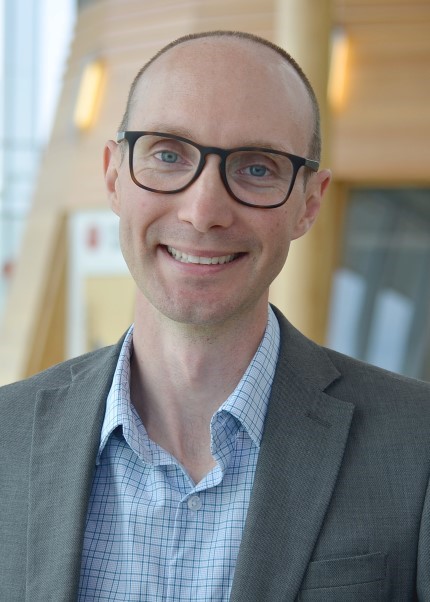
Tyler Finley

(He, Him, His)

Communications Manager

Engineering
Office: EME4241
Email: tyler.finley@ubc.ca


Niloofar Akbarian-Saravi at UBCO

Dr. Niloofar Akbarian-Saravi shares her UBC Engineering experience

At their core, sustainable supply chains are about resilience. For Dr. Niloofar Akbarian-Saravi, those same themes have shaped the past six years of her academic journey at UBC.

What began as a PhD in Mechanical Engineering became an experience marked by interdisciplinary collaboration, industry partnerships and opportunities that stretched across sectors, including manufacturing and renewable energy, and international borders.

As she prepares to join MacEwan University’s Triffo School of Business as a Tenure-track Assistant Professor, Dr.  Akbarian-Saravi reflects on a period of rewarding growth and an exciting chapter ahead.

As you prepare to leave UBC Okanagan and begin your new role, what are you reflecting on most about your time with the School of Engineering?

What stands out most is how this environment enabled me to apply supply chain management expertise across a spectrum of bio-industrial applications, from recycling and reverse logistics to manufacturing and process scale-up, with the consistent aim of ensuring the most sustainable pathway for delivering these innovations to market.

I arrived at UBC in 2020 as a PhD student in Mechanical Engineering, and I am leaving having taught hundreds of students, led industry-funded research projects, and mentored undergraduate and graduate students and trainees.

I am grateful for the institutional trust and the opportunity to build something enduring here through problem-driven research grounded in collaboration and real-world application.

How has your time as a postdoctoral researcher shaped your growth as both a researcher and an educator?

The postdoc period pushed me to lead, not just contribute. I moved from developing models as a PhD student to directing multi-partner projects across a widening range of circular economy applications.

Across these projects, my objective was consistent: to optimize the underlying systems for each customized application while developing mathematically rigorous, generalizable methods that could be replicated across sectors rather than one-off solutions.

That experience taught me how to translate research into something a company or funder can actually use, and it broadened my vision of what a sustainable supply chain management research program can contribute.

As an educator, this period is also when I transitioned into UBCO’s Faculty of Management to teach industrial-engineering-adjacent, quantitative courses. I bring the same evidence-based, applied mindset into the classroom that I use in my research.

Your research explores circularity in bioindustrial supply chains and the role of emerging technologies such as artificial intelligence. What excites you most about this area of research, and why does it matter?

What excites me is the convergence point: where engineering performance, economics, environmental impact and social outcomes all have to be balanced at once, under real uncertainty.

Bio-industrial supply chains are exactly where this convergence plays out, and getting the decision-support right can determine whether a sustainable technology actually scales or stays stuck in the lab.

That same approach is now shifting toward AI-driven, adaptive decision support that combines expert judgment with data to support prescriptive decision-making under data scarcity.

Across all of this work, I want this research to lead toward decision-support systems that are good enough, and usable enough, that industry partners and policymakers actually adopt them, not just read about them.

Looking back, what accomplishments or milestones are you most proud of during your time at UBC Okanagan?

A few stand out.

Winning first place in the Institute of Industrial and Systems Engineers (IISE) Best Student Paper Competition in 2024 was a milestone because it validated years of methodological work.

I’m also proud of translating that research into industry impact, especially leading a tender-awarded international project in the Basque Region of Spain on sustainable sawmill supply chains.

Alongside these efforts, my growth in entrepreneurial skills culminated in founding SustainPro Solutions Inc., a sustainability-focused business intelligence platform that is still growing today. That venture is where my research and entrepreneurial instincts truly came together.

And being recognized by students with the “Thank a Prof” Award this year meant a great deal, because teaching well while running an active research program was always something I worked hard at.

Were there any people, experiences or opportunities at UBC Okanagan that had a particularly meaningful influence on your journey?

My co-supervisors, Dr. Abbas S. Milani and Dr. Taraneh Sowlati, shaped how I think about research, rigorous, but always grounded in real-world application. Their expertise was complementary and shaped my thinking on how to connect engineering with management-facing decision tools, which is really the throughline of my entire research program.

Working within the Composites Research Network (CRN) laboratory and later the Materials and Manufacturing Research Institute (MMRI) exposed me to industry partners and interdisciplinary collaborators I wouldn’t have met otherwise. The Lab2Market Validate program and entrepreneurship@UBC were also pivotal. They fundamentally changed how I think about research translation.

My international project in the Basque Country was especially formative. It was my first international research experience, and it shifted my orientation from simply pursuing publications to building tools that actually solve a problem in practice.

Traveling to and working directly with stakeholders in a different region also gave me a broader perspective: these sustainability and supply chain challenges are not tied to Canada geographically. The frameworks I build can be applied anywhere.

I’d also point to resilience as its own kind of influence. I began my PhD during the COVID-19 pandemic and relocated to Canada alone as an immigrant woman. That required real adaptability, and it strengthened my ability to lead and keep research moving under uncertainty. That willingness to work through discomfort became a defining part of how I approach interdisciplinary collaboration.

You will soon be joining the Triffo School of Business at MacEwan University as a tenure-track Assistant Professor. What are you most looking forward to in this next chapter of your career?

I’m looking forward to building my own research program and lab from the ground up, with the freedom to set its direction fully.

I plan to launch a research lab focused on advancing AI-enabled, risk-aware decision analytics for sustainable and circular supply chains, with the broader goal of helping industries move toward net zero by 2050 and beyond.

I’d also like to keep growing the applied, industry- and internationally-funded model that has defined my work so far, since that’s where I’ve seen research actually change practice, and to keep mentoring the next generation of engineering and management professionals, particularly women along the way.

How do you hope your research program will evolve over the coming years, particularly at the intersection of circular economy principles, supply chains and artificial intelligence?

Part of what motivates this direction is a gap I see in the broader field: circular supply chains are increasingly recognized as central to sustainable, resource-efficient logistics, but the research base is still dominated by conceptual frameworks rather than the quantitative, model-based tools needed to actually design these systems.

Closing that gap, building generic, replicable, optimization-based frameworks that integrate these dimensions together, is a core part of what I want my research program to contribute.

What advice would you offer to graduate students, postdoctoral researchers or early-career academics who are hoping to build meaningful research careers and pursue faculty positions?

Anchor your research in real problems and real partners early, it sharpens your thinking and opens doors that purely theoretical work doesn’t.

Say yes to mentorship, in both directions: being mentored, and mentoring others, even as a PhD student. It builds the leadership and communication skills that matter as much as technical depth when you’re going up for a faculty role.

Don’t separate teaching from research. They make each other better.

And, finally, take grant writing and entrepreneurial training seriously, even if it feels tangential to your core research. Learning to translate your work for funders, industry partners and the public is what turns a good idea into a funded, lasting research program.

The School of Engineering congratulates Dr. Akbarian-Saravi on her appointment to the Triffo School of Business at MacEwan University and thanks her for the many contributions she has made to our community. We wish her every success as she builds this exciting next chapter of her career.

EME Building from the air at UBCO

Stronger infrastructure. Smarter communications. Cleaner energy. Better health technologies. 

Six UBC Okanagan School of Engineering researchers have received a combined $1.55 million in Discovery Grants from the Natural Sciences and Engineering Research Council of Canada (NSERC) for work advancing solutions to some of today’s most pressing challenges. 

The grants are part of a broader investment announced by NSERC, which is supporting 19 research projects through more than $4.3 million in funding at UBC Okanagan. Across both UBC campuses, nearly $45 million was awarded to 199 new research projects and programs. 

Congratulations to the following School of Engineering researchers and their teams awarded in this round: 

  • Dr. Shahria Alam received $260,000 for research advancing transformative strategies for infrastructure resilience through experimentation and emerging technologies. 
  • Dr. Joshua Brinkerhoff received $260,000 to explore multiscale modelling of onshore and offshore wind farms, helping improve renewable energy systems. 
  • Dr. Anas Chaaban received $260,000 to investigate AI-native communication schemes enabled by stacked-intelligent-surface neural networks, advancing the future of wireless communications. 
  • Dr. Ian Foulds received $190,000 to develop point-of-care systems for quantifying biomarker panels, supporting faster and more accessible health diagnostics. 
  • Dr. Kasun Hewage received $365,000 for research focused on planning and developing climate-resilient, occupant-centric net-zero-energy building clusters. 
  • Dr. Loïc Markley received $215,000 to study periodic structures and metasurfaces for electromagnetic wave control and channel enhancement in advanced wireless systems. 

“These projects reflect the depth and diversity of research excellence within our School, spanning areas that are both timely and of critical importance to communities across the world,” said Dr. Will Hughes, Director of the School of Engineering. “Congratulations to all our researchers awarded this week—we are proud to see you recognized, and look forward to watching your good work have an impact.” 

NSERC Discovery Grants are among Canada’s most prestigious sources of research funding, supporting long-term programs of inquiry that advance scientific and engineering knowledge while creating opportunities for students and trainees to contribute to leading-edge research. 

James Seabrook

James Seabrook at Vitalis, the company he founded in Kelowna, BC.

James Seabrook graduated from UBC Okanagan’s engineering program in 2011 and didn’t leave the region. He walked into a shop in Kelowna, got a job and started building his own business.

Today, Vitalis Equipment Technology Inc. employs more than 70 people and counts half its engineering team as UBCO graduates. It’s poised for global growth, by extension sharing related economic benefits across the Okanagan Valley.

They build something many people never see—large-scale heat pumps that can heat or cool warehouses, hospitals or even university campuses using carbon dioxide instead of synthetic gases.

The Kelowna-based manufacturer has already installed the largest CO₂ air-source heat pump in North America, at the university where its founder studied.

That installation, at UBC Okanagan in Kelowna, is more than a milestone. It’s the proof point that positions a BC interior manufacturer to compete in a sustainable heating and cooling market that analysts expect to grow rapidly.

“It’s the foundational project of a whole new product line that isn’t in the market yet,” says Seabrook. “But we’ll have years of operating experience with it when the market emerges.”

Read the full story

Brooke Franchuk

Brooke Franchuk with team members at Garmin.

For Brooke Franchuk, engineering is about creating technologies that can make a meaningful difference in people’s lives.

A 2018 graduate of the Mechanical Engineering program at UBC Okanagan School of Engineering, Franchuk now works at Garmin, where she helps develop wearable technologies designed to support health and well-being.

Her journey highlights how engineering skills can lead to careers at the intersection of technology, design and human health.

It’s incredibly rewarding to create products that have a meaningful impact on people’s everyday lives. I like being part of the development of devices that people rely on and trust to perform accurately and consistently.

In a recent UBC Engineering spotlight, Franchuk reflects on her path from engineering student to professional engineer and shares how wearable technology is helping shape healthier futures.

Read the full profile from UBC Engineering.

Dr. Qian Chen stands on a construction site with her hands in the air, wearing a VR helmet. She points to something in the air, seeing it through her VR lens.

Dr. Qian Chen leads the Construction Integration and Digitalization Lab at UBC Okanagan.

Dr. Qian Chen, Assistant Professor of Civil Engineering with UBC Okanagan’s School of Engineering, has been named one the campus’ six inaugural Impact Research Chairs in recognition of her leadership in advancing digital construction technologies and sustainable housing solutions.

The new program supports researchers whose work is driving meaningful impact within communities, industries and society.

Dr. Chen’s research focuses on digital and immersive technologies, optimization algorithms and fabrication-aware design to accelerate the transformation of the construction sector. Through her Construction Integration and Digitalization Lab, she works closely with industry and community partners to develop technologies that improve productivity, sustainability and affordability in the built environment.

Her work has already earned national recognition, including a recent honour from the Canadian Society for Civil Engineering and funding through the B.C. Knowledge Development Fund to advance Digital Integration for Robotic Fabrication in Construction (DIRFIC), a project aimed at streamlining digital workflows and enabling more rapid, affordable housing solutions.

“I am driven by a simple, urgent question: how can we fundamentally change the way buildings are made so future prefabrication and construction methods become more rapid, high-quality and low-waste?” says Dr. Chen. “This Chair will enable me to find answers by supporting the building of a novel construction platform using robotics and AI that can be adopted, trusted and scaled among the construction and prefab manufacturing industry.”

The School of Engineering congratulates Dr. Chen and her research team on this well-deserved recognition!

Lisa Tobber and team

UBCO Engineering Assistant Professor Dr. Lisa Tobber (right) with Postdoctoral Research Fellow Dr. Ana Isabel Sarkis Fernandez

Dr. Lisa Tobber’s collaboration with New Zealand researchers aims to strengthen the safety and resilience of prefabricated buildings 

A UBC Okanagan engineering researcher is helping lead an international effort to make buildings safer in earthquake-prone regions. 

Dr. Lisa Tobber, Assistant Professor in the School of Engineering, has been awarded a Catalyst International Leader Fellowship from New Zealand’s Royal Society Te Apārangi. The fellowship will support a three-year research collaboration between UBC and the University of Canterbury focused on improving the seismic performance of prefabricated concrete buildings through the development of high-ductility structural connections. 

The project addresses a challenge shared by both Canada and New Zealand: how to safely expand the use of prefabricated construction while maintaining high standards of seismic resilience.  

Although prefabrication can improve housing affordability, construction efficiency and sustainability, the structural connections used to join building components remain a critical area for improvement in regions vulnerable to earthquakes, notes Dr. Tobber. 

Working alongside Professor Geoffrey Rodgers of the University of Canterbury, Dr. Tobber will combine expertise in prefabricated concrete systems, seismic damping technologies, large-scale experimental testing and advanced nonlinear modelling to develop new connection technologies capable of improving building performance during earthquakes.  

The research will include coordinated testing programs in both countries and will ultimately support the development of practical design guidance for industry. 

“This fellowship is especially meaningful because it supports a long-term collaboration between UBC and the University of Canterbury on a problem that matters in both Canada and New Zealand: how to make prefabricated construction safer and more resilient in earthquake-prone regions,” says Dr. Tobber. 

“The project will allow us to combine expertise in precast concrete systems, seismic damping, large-scale experimental testing and nonlinear modelling to develop high-ductility connection technologies that are practical for real buildings. I am particularly excited that the fellowship supports sustained time in New Zealand, which will help build a deeper research partnership, create training opportunities for students and support translation of the work into design guidance for industry,” she adds. 

The fellowship will support multiple research exchanges to New Zealand, culminating in an extended sabbatical residency that will allow Dr. Tobber and her collaborators to undertake large-scale testing, develop industry guidelines and pursue future joint research initiatives. 

Dr. Lisa Tobber

Dr. Lisa Tobber in the lab at UBC Okanagan.

Since joining UBC Okanagan in 2021, Dr. Tobber has established a nationally recognized research program focused on resilient and sustainable building systems. Her work has helped advance seismic design approaches for prefabricated concrete structures and contributed to the development of Canadian engineering standards and building codes. In 2025, she was named a Peter Wall Fellow, one of UBC’s most prestigious research distinctions, recognizing researchers whose work has the potential to address significant societal challenges.  

“Dr. Tobber’s work focuses on practical challenges that affect communities around the world, and this fellowship reflects both the quality and real impact her research is having from the local to the international level,” says Dr. Will Hughes, Director of the School of Engineering. “We’re pleased to see Lisa’s expertise recognized internationally and excited about the opportunities this partnership will create for research, student training and knowledge exchange between Canada and New Zealand.” 

The Catalyst International Leader Fellowship supports international research partnerships that create new knowledge, strengthen research capability and address issues of global significance. Through this collaboration, researchers from both countries will work toward safer, more resilient and more scalable approaches to prefabricated construction in seismic regions. 

Quinn Soon and family

Quinn Soon with family at Convocation. His mother, Dr. Zoë Soon, is a UBCO professor of biology.

2026 UBC Okanagan engineering graduate Quinn Soon reflects on leadership, sustainability and creating impact through engineering

Meet UBCO 2026 BASc Civil Engineering Graduate Quinn Soon

Growing up in the Okanagan, Quinn Soon was drawn to engineering by a desire to help address some of society’s most pressing challenges, including sustainability, housing affordability and community resilience. Throughout his time at UBCO, he combined academic excellence with hands-on learning, leadership and service, graduating with a Bachelor of Applied Science in Civil Engineering and 20 months of co-op experience.

A leader in the School’s sustainability community, Quinn helped guide UBCO School of Engineering’s award-winning Solar Decathlon team to a second-place international finish while gaining valuable industry experience through co-op placements in construction and project coordination. Outside the classroom, he remained committed to giving back through Hockey 4 Youth, a program that provides free ice time, equipment and coaching to children who might not otherwise have the opportunity to play hockey.

Recognized as the 2026 Head of Class and recipient of the Engineers and Geoscientists BC Prize in Engineering Okanagan (Overall), Quinn recently began his career as an Engineer-in-Training with R+A Engineering in Vernon, where he is contributing to housing projects across Western Canada.

Read on as Quinn reflects on his engineering journey, the experiences that shaped him and the opportunities that lie ahead.

Tell us a bit about yourself

I am from Vernon, BC, and growing up there, I enjoyed playing soccer and hockey, skiing at Silver Star, and hiking around the lakes and mountains. Before attending UBCO, I graduated from the french immersion program at W.L. Seaton Secondary School. I still live in Vernon and still play soccer every week. I also now help coach a program called Hockey 4 Youth which provides free ice time, hockey equipment, and instruction for kids who wouldn’t have otherwise had a chance to play hockey.

What drew you to UBC Okanagan and the School of Engineering?

When I was in high school, I became passionate about sustainability and addressing the environmental and affordability crises in Canada. I decided that I wanted to pursue a career that would allow me to contribute to solutions for these complex challenges. It became clear that engineering could be a good fit for me to combine my interest in math and science with my motivation to help solve real world problems.

UBC’s reputation for teaching about sustainability in engineering appealed to me, and I hoped to stay in the Okanagan where I grew up, so UBC Okanagan was at the top of my list for where I wanted to go after graduating from high school.

What is one moment or experience that defined your time at UBCO?

Quinn Soon with E at UBCOIn my second year, I joined an engineering club called “Innovate, Design, Sustain” that was focused on engineering projects related to sustainability. I was lucky to meet many innovative and passionate students and professors through this club.

The club’s biggest project each year was participating in the Solar Decathlon, which was an annual collegiate competition organized by the US Department of Energy. The goal of the Solar Decathlon was to design a high-performance, sustainable, and scalable house. By the next academic year, I had become one of the leaders on the 2024 Solar Decathlon team.

Along with the other leaders of the team, I travelled to Golden, Colorado, to present our project at the final competition event hosted by the National Renewable Energy Lab. We placed 2nd in our division out of 47 teams from around the world, which capped off what had already become the highlight of my time at UBCO.

Did you participate in co-op, undergraduate research, or other hands-on experiences? How did they shape your path?

I did 20 months of co-op working as a project coordinator at two different construction companies in Kelowna. These were my first steps into the real world of construction and engineering, and I learned a lot about how to help coordinate each stage of the construction process.

I enjoyed my time in co-op because I was lucky to be supported by amazing colleagues and managers, some of whom were UBCO engineering graduates who understood exactly where I was at in my education and how to help me continue to develop professionally.

My co-op experiences have shaped my current career path, as they allowed me to gain a better understanding of my own strengths, the types of roles that I most enjoy, and how to continue improving myself to become a better engineer.

Can you share a project, course, or professor that had a lasting impact on you? Why?

I have had many professors who have had lasting impacts on me, but I will never forget the classes I had with Dr. Mohammad Tiznobaik. His passion for teaching was obvious, and it was clear how much he cared about preparing us to be future engineers.

My new EIT role involves applying many of the concepts that I learned from his course on the design of steel and timber structures. I have found that his course has prepared me well to understand the applicable design codes, standards, and handbooks to do structural design work for real buildings.

What are your plans after graduation? What excites you most about this next chapter?

I have successfully registered as an Engineer-in-Training (EIT), and I have started working at a structural engineering firm in Vernon called R+A Engineering.

R+A Engineering is currently involved in many housing projects across BC and Alberta, and I have already had the chance to start contributing to the structural design of several of these projects. Rising housing costs are one of the biggest concerns of my generation, so I am excited to work on projects that benefit communities by providing more housing options.

I am also excited to have the opportunity to continue learning every day from the experienced professionals I am now working alongside.

How has your Bachelor of Applied Science degree prepared you for your next steps?

I am now a month and a half into my new role as a structural EIT, and since day two in the office, I have been able to contribute to design work thanks to the foundational knowledge that I developed during my degree.

The structural engineering courses that I took with Dr. Ahmad Rteil, Dr. Lisa Tobber, and Dr. Mohammed Tiznobaik have proven to be particularly valuable as much of the content is directly applicable to real world design. Equally important to succeeding in my new role are the problem solving and technical skills as well as the industry experience that I have gained from my other classes, design club projects, and co-op jobs. However, I know that I still have a lot left to learn.

One of the fun parts of being an engineer is that the opportunities for learning never end, so I approach every day with the goal of learning more just like I did when in school.

What advice would you give to future or current engineering students?

Find ways to actively participate in the engineering community on campus. I know that it’s not always easy to put yourself out there with all the demands you have on your time and energy as a student, but it’s more than worth it to join one of the engineering clubs or societies on campus.

I found that working on club projects taught me a lot about being an engineer, and it also provided me with a lot of great memories, new friends and industry connections.

Quinn Soon receiving award

Quinn Soon receiving the Engineers and Geoscientists BC Prize in Engineering Okanagan (Overall) on graduation day.

You were recently recognized as Head of Class at Convocation. You also received the Engineers and Geoscientists BC Prize in Engineering Okanagan (Overall). What does this RECoGnition mean to you?

It feels amazing to be receiving the awards and recognition. It makes me very thankful to everyone who has supported me and helped me get to this point including my family, friends, professors, teachers, classmates, and everyone I met through my design club and co-op experiences.

The support I have received from everyone was really what made it possible for me to be graduating with these honours. I have always been motivated to make the most of the support I have received and to build the best start I could towards an engineering career that will allow me to do work that is meaningful for me.

I’m proud of what I’ve accomplished so far, and I’m excited for what is yet to come in my career.

Congratulations, Quinn, on your graduation and on being named Head of Class for the School of Engineering’s Class of 2026. On behalf of the entire School community, we thank you for your leadership, dedication and contributions both inside and outside the classroom. We wish you every success as you begin your engineering career and look forward to seeing the impact you will make in the years ahead!

Shayan Narani

A UBC Okanagan School of Engineering doctoral student is being recognized as part of Innovation UBC‘s latest Venture Founder cohort, highlighting the growing impact of engineering-led entrepreneurship across the university.

Shayan Narani, founder and CEO of Cement Dioxide, was recently featured by Innovation UBC among a select group of founders advancing ventures with the potential to address some of today’s most pressing challenges. Narani is currently completing his PhD in Civil Engineering under the supervision of Dr. Sumi Siddiqua.

Narani’s company is developing high-strength, low-emission concrete using bio-derived byproducts and carbon capture technologies. The approach aims to significantly reduce the carbon footprint of concrete production while maintaining the performance and durability required for modern infrastructure.

“Venture Founder was my first real exposure to entrepreneurship,” said Narani. “The program gave me the tools to study my market, connected me with industry, and walked me through the full journey from idea to launch. What stood out most was the program team, who are genuinely supportive and committed to creating a space where students can explore whether entrepreneurship is right for them, without pressure.” 

As part of Innovation UBC’s Venture Founder program, Narani worked alongside mentors, industry experts and fellow entrepreneurs to further develop his venture and explore pathways to commercialization. Reflecting on the experience, he noted that the program provided valuable tools, industry connections and support as he moved from idea to launch.

The recognition reflects the growing entrepreneurial mindset among UBC Okanagan engineering students and alumni, who are increasingly translating research, technical expertise and innovative ideas into ventures with real-world impact.

Read the full story from Innovation UBC.

Two UBC Okanagan School of Engineering professors have received prestigious national honours from the Canadian Society for Civil Engineering (CSCE), recognizing their contributions to research, innovation and the advancement of the profession. The awards were presented during the 2026 CSCE Annual Conference in Québec City. 

Dr. Shahria Alam awarded Horst Leipholz Medal 

Dr. Shahria Alam

Dr. Shahria Alam with CSCE President Dr. Jeff Rankin (right).

Dr. Shahria Alam, Professor and Tier 1 Principal’s Research Chair in Resilient and Green Infrastructure, has received the CSCE Horst Leipholz Medal. 

The award recognizes outstanding contributions to engineering mechanics research and practice in Canada and is one of the society’s highest honours in the field. 

An internationally recognized leader in resilient infrastructure, Alam has authored more than 500 peer-reviewed publications and has helped shape national and international engineering standards. His research focuses on sustainable and resilient infrastructure systems, with applications ranging from seismic resilience to advanced construction materials. 

Beyond his research contributions, Alam serves as Director of UBC Okanagan’s Green Construction Research and Training Centre and previously served as Vice President, Technical Programs, and Chair of the Engineering Mechanics & Materials division with CSCE. He is also a Fellow of the Engineering Institute of Canada, the American Society of Civil Engineers and the Canadian Society for Civil Engineering. 

Dr. Alam’s reflection

“Receiving the Horst Leipholz Medal is a tremendous honour and meaningful recognition of my career. Named after Professor Horst Leipholz, whose pioneering work shaped engineering mechanics in Canada, this award represents excellence in research, practice, and leadership in our profession. 

I share this honour with my students, postdoctoral fellows, colleagues, collaborators, and industry partners, whose dedication and support have been integral to our collective achievements. Throughout my career, I have strived to bridge research and practice to develop safer, more resilient, and sustainable infrastructure while mentoring the next generation of engineers. 

I am also deeply honoured to join the distinguished group of past recipients whose contributions have advanced engineering mechanics and structural dynamics nationally and internationally. This recognition reflects not only my own efforts but also the support and guidance of my mentors, former teachers, and supervisors, whose wisdom and encouragement helped shape my academic and professional journey. I remain profoundly grateful for their lasting influence. I am especially grateful to my family, whose love, patience, and support have been instrumental in this journey. 

I sincerely thank the Canadian Society for Civil Engineering and the Engineering Mechanics and Materials Division for this recognition. I accept this award with humility, gratitude, and a renewed commitment to advancing our profession and contributing to society through engineering excellence.” 

Watch Dr. Alam’s award presentation.   

Dr. Qian Chen receives Young Professional Engineer Award 

Dr. Qian Chen

Dr. Qian Chen with CSCE President Dr. Jeff Rankin.

Dr. Qian Chen, Assistant Professor of Civil Engineering, has received the CSCE Young Professional Engineer Award. 

Presented annually, the award recognizes a CSCE member who has demonstrated outstanding accomplishments as a young professional engineer. 

Chen leads UBC Okanagan’s Construction Integration and Digitalization (CID) Lab, where her research focuses on advancing digital construction technologies, automation and robotics. A defining contribution of her research program is the development of DIRFIC (Digital Integration for Robotic Fabrication in Construction), a multi-axial cyber-physical robotic fabrication platform dedicated to the mass customization of buildings. 

Her work is helping to advance innovation in industrialized construction, digital fabrication and circular economy approaches in the built environment. In addition to her research leadership, Chen is actively involved in initiatives that support women and underrepresented groups in engineering and contributes to knowledge sharing through professional organizations including Canadian Society for Civil Engineering and the International Association for Automation and Robotics in Construction. 

Dr. Chen’s reflection

“Receiving the CSCE Young Professional Engineer Award is both an honour and a reflection of the incredible people, including my students, colleagues and mentors, who I’ve had the opportunity to work with throughout my journey. This recognition is especially meaningful because it highlights not only just a personal contribution but also the dedication and success of my student trainees who have supported and strengthened my research program. Their curiosity, hard work, and commitment to learning new things have been a constant source of my motivation and inspiration. 

Engineering research and practices are never an individual effort, and I have learned that it grows through collaboration, mentorship, and shared ambition. I’m extremely grateful to my mentors, colleagues, and students for contributing to a supportive environment where ideas can thrive and meaningful impact can be created for our community. 

I’m proud to represent the values of innovation and perseverance in my school, the whole professional society like CSCE and beyond, that continue to shape my career ahead. I hope this recognition encourages everyone especially young engineers and researchers to stay curious about challenges and new solutions in construction and civil engineering, and believe in the value of teamwork in building a better future.” 

School of Engineering celebrates Dr. Alam and Dr. Chen

“These honours reflect the distinct and considerable impacts Drs. Alam and Chen are creating through their research leadership and service,” says Dr. Will Hughes, Director of the School of Engineering.

“In addition to elevating our School, their good work is helping to advance knowledge, strengthen industry practice and inspire the next generation of engineers at the national level. We are proud to see them recognized by their peers across Canada.” 

About the Canadian Society for Civil Engineering

The Canadian Society for Civil Engineering is the national learned society of the civil engineering profession in Canada and annually recognizes individuals whose work has made significant contributions to engineering research, practice and leadership. 

MDes students learning outside

The MDes program learning in Woodhaven Regional Park.

UBC Okanagan’s Master of Design (MDes) professional graduate program recently welcomed its inaugural cohort of students.

Rooted in critical design thinking, creative practice and design principles, the program—collaboratively delivered by the School of Engineering (SoE) and Faculty of Creative and Critical Studies (FCCS)—empowers students to tackle real-world challenges alongside industry, community and public sector partners.

In this blog series, Professor Dr. Kenneth Chau and the MDes Team reflect on the cohort’s journey as they work together to solve pressing societal problems and embrace new ways of learning, teaching and innovating.

MDes: One Month In

Dear MDes Community,

One month into the inaugural Master of Design cohort, we find ourselves reflecting on a question that has surfaced repeatedly throughout the journey so far: What if graduate education looked different?

Not different for the sake of being different, but different because the challenges facing our communities increasingly demand new ways of learning, collaborating, and creating change.

Over the past month, our students have spent time in municipal offices, heritage centres, forests, wetlands, entrepreneurial forums, community organizations, and countless conversations with people working to improve the places they care about. They have met entrepreneurs, city leaders, artists, researchers, educators, investors, community builders, and knowledge holders. They have explored the histories, opportunities, tensions, and aspirations that shape the Okanagan. And perhaps most importantly, they have reflected.

MDes students tour water facility in Lake Country

MDes students and faculty tour Lake Country District hydroelectric facilities.

Every week, the cohort gathers to make sense of what they are seeing, hearing, and experiencing.

Together, we ask questions about leadership, creativity, innovation, community, place, purpose, and the role each of us might play in contributing to a better future.

What is emerging from these conversations is a growing realization that many of the challenges we face today cannot be understood through a single lens. The issues that keep municipal leaders awake at night are connected to housing, infrastructure, ecology, economics, governance, culture, and human behaviour. The opportunities pursued by entrepreneurs are often rooted in the same systems. Community organizations, educators, artists, researchers, and business leaders frequently find themselves navigating different parts of the same complex landscape.

MDes students with Okanagan Lake in the background

The MDes program explore downtown Kelowna, Okanagan Lake in the background.

To engage meaningfully with these realities requires more than expertise alone.

It requires curiosity.

It requires the ability to connect ideas across disciplines.

It requires comfort with uncertainty.

It requires learning how to listen deeply before acting.

In many ways, the first month of MDes has been less about teaching students what to think and more about helping them learn how to see.

To see opportunities where others see constraints.

To see relationships where others see isolated problems.

To see themselves not simply as students preparing for the future, but as active participants in shaping it.

This shift has been one of the most encouraging developments so far. Increasingly, the cohort is beginning to think less like students completing assignments and more like a studio engaged with real people, real challenges, and real possibilities. Conversations that begin during a site visit continue over coffee. Questions raised during reflection sessions become project ideas. Community introductions lead to collaborations. New opportunities emerge unexpectedly through relationships.

Students and guests at Woodhaven Regional Park

MDes students, faculty and guest speakers at Wood Haven Regional Park.

The boundaries between classroom, community, and workplace are becoming increasingly blurred. While we are still early in the journey, we are beginning to wonder whether this may be one of the most important lessons emerging from the program.

Perhaps education is at its best when learning is not separated from life.

Perhaps students grow most when they are trusted with meaningful responsibility.

Perhaps innovation emerges not from studying systems at a distance, but from becoming active participants within them.

We do not yet have definitive answers to these questions.

In truth, we are still experimenting.

We are learning alongside the students.

We are testing assumptions, discovering what works, identifying what does not, and continuously adapting. Some ideas have exceeded expectations. Others have revealed new questions. Much remains uncertain.

Yet despite that uncertainty, there is a growing sense that something meaningful is taking shape. What began as a graduate program is gradually becoming something else: a community of builders, thinkers, creators, and changemakers connected by a shared desire to contribute positively to the world around them.

Kenneth Chau and the MDes Team

about the Master of Design program

The UBC Okanagan Master of Design (MDes) program brings together creativity, human-centred design, entrepreneurship and community-engaged learning to help students tackle complex challenges and create meaningful impact.

LEARN MORE