
Growing up, I loved playing with Lego and making things, and I’ve always been into math and science. I realized engineering could be a way for me to pursue these interests and contribute my skills in ways that could make the world a better place.
My early engineering interest was inspired by my dad, who was incredibly multi-skilled—a Red Seal electrician, millwright and engineering technologist specializing in water utilities. His work always fascinated me. I vividly remember when I was about six years old and our family was moving from Squamish to Trail. After our moving sale, each of us kids was allowed to keep just one thing. I chose a box of capacitors and resistors. When I was 11 years old, my dad bought five 486DX2 computers and two printers for $10 at a local auction.
Engineering became a tangible idea for me when I saw my parents building a 40-foot motorhome when I was a kid. Watching them design the motorhome, choose the materials and build it was very inspiring and got me thinking about construction and the different ways materials can be used. I competed at the Canada-Wide Science Fair with a project on the structural insulated panels they chose for our motorhome and how they could be used in remote and emergency housing situations.
A few years after graduating, Natik co-founded a software development firm that has since launched three products, including Prompt Genie, a tool for generating strong prompts so users can get the most out of AI chatbots. The UBC Electrical Engineering graduate says the skills he gained in engineering have supported his entrepreneurial endeavours, highlighting the importance of investing time in the first stage of the design cycle – understanding the problem – before generating potential solutions.
For Sathika, engineering is a values-driven profession that enables her to make a difference. She exemplifies this in her work for the BC Ministry of Transportation and Infrastructure, where she manages projects to ensure the safety of bridges and culverts. She also volunteers her time mentoring students through Engineers in Action, which has included travelling to Eswatini to build a 73-metre suspended bridge completely by hand and link a community to health care and education.
On his LinkedIn profile, Aditya (Adi) Chaudhuri describes himself as an “engineer transforming the public sector.” Currently heading up a transformation initiative at Global Affairs Canada, Adi continues to explore the potential of an engineering career. Recognized as an Alberta Top 30 under 30 in 2018 for his contributions in the non-profit sector, Adi serves many organizations and causes, including leading the Calgary Professional Chapter of Engineers Without Borders. A lifelong student of Hindustani classical music, Adi is a professional artist and arts leader dedicated to bringing South Asian arts into the mainstream.

Killam doctoral student Rubaiya Rumman.
Killam Laureate Rubaiya Rumman is originally from Bangladesh. She completed her bachelor’s and master’s in civil engineering from Bangladesh University of Engineering and Technology (BUET) and worked as a lecturer there after graduation. She started her PhD journey at UBC Okanagan in 2021. Apart from her achievements in academia and research, Rubaiya is a professional singer and is currently serving as the President of the Engineering Graduate Students Society at UBCO.
Tell us a bit about yourself:
I was born in Dhaka, Bangladesh, an overpopulated city with lots of scope for infrastructural development. My dad, a civil and structural engineer working for the Bangladesh government, was my inspiration in choosing to be in this field for my undergraduate studies. Apart from my academic and research career, I am also a professional singer; I have been enlisted as a vocal artist in the national radio of Bangladesh since 2018. Balancing my extra-curricular and academic interests has always been a strong suit of mine as I am currently the President of the Engineering Graduate Students Society at UBCO, where I serve my fellow engineering graduate students by creating a supportive environment.
Tell us about your academic journey leading up to your PhD studies.
Besides my academic endeavours, I have been very interested in research since my undergraduate studies. I was specifically interested in sustainable and durable concrete, as it is the most used construction material on earth and highly carbon-intensive. I was interested in improving the conditions of the existing structures of Bangladesh, as well as innovative and green concrete materials for solving the sustainability issues. I completed my undergraduate and master’s degrees in civil engineering from a top engineering university in Bangladesh, Bangladesh University of Engineering and Technology (BUET). I topped my class by achieving a record GPA of 3.99 out of 4.00 in the civil engineering department of BUET. I also scored a perfect GPA of 4.00 in my master’s. I had the opportunity to teach brilliant minds at BUET as I worked as a Lecturer there.
What inspired you to pursue a PhD degree, and why did you choose UBC Okanagan for your graduate studies?
Being in academia and my passion for research motivated me to pursue PhD at a top University in the world, the University of British Columbia. The expert faculty members and cutting-edge laboratory facilities at UBCO led me to apply here. I was granted admission here with flying colors with a 4-year international doctoral fellowship. Later I also received some highly prestigious awards like the NSERC CGS-D, the Killam Doctoral Fellowship, the American Concrete Institute (ACI) Master Builders Solutions Concrete Materials Scholarship, and the ACI Foundation Fellowship.
Tell us about your PhD research. Is your current research related to your Master’s research or completely different?
Concrete is the most used construction material in the world because of its versatility. However, concrete’s main constituent, cement, is highly carbon intensive at its production. Considering the huge amount of concrete produced annually in the world, it is also solely responsible for a total of 8% emissions out of the total annual global emissions. Since cement is the main culprit behind these high emission levels, my focus is to reduce the cement use in concrete by replacing it with a waste material – wood fly ash.
Previously, coal fly ash (a byproduct of coal-fired powerplants) has been used in cement production to reduce its carbon footprint and high cost; this also means it is a popular research topic in the area of concrete. However, coal powerplants are also being shut down because of their environmental impacts. Therefore, in search of a substitute for coal fly ash, I am considering wood fly ash to take its place. Wood fly ash comes as a byproduct for producing clean and renewable biomass energy. About 70% of its current production goes to the landfill. I am investigating the potential of using wood fly ash as a novel supplementary cementitious material in concrete to reduce its carbon footprint and promote sustainability.
How did you find your community at UBCO? (For example: clubs, within your research group, lab, etc.)
From the beginning of my PhD journey, I have been part of the Applied Laboratory for Advanced Materials and Structures (ALAMS) headed by Dr. Shahria Alam. This is a leading lab doing excellent research in structural engineering and engineering materials. The friendly atmosphere in the lab made me feel comfortable right away, despite the culture being so different from where I come from. There is a lot of room to improve oneself in our lab – everyone is very encouraging. As a PhD student, I also have the opportunity here to mentor undergraduate and master’s students.
I would also like to mention the Engineering Graduate Students Society which I am a part of now. Being the President there, I get to explore leadership and teamwork among other wonderful graduate students. I get to arrange events facilitating my engineering graduate student peers, which boosts my confidence and broadens my outlook.
What has been the most rewarding part of your UBCO experience so far?
The friendships I have built within my research group and the recognition I receive from my supervisor have been the most rewarding aspects of my UBCO experience. I have always believed that I need a friendly environment to grow as a person, which I got at UBCO. Scholarships and fellowships are tangible achievements, but it is the underlying support and nurturing environment that are most valuable.
Scholarships and fellowships are tangible achievements, but it is the underlying support and nurturing environment that are most valuable.
What challenges have you faced during your time at UBC, and how have you grown or adapted as a result?
One of the biggest challenges I faced was COVID-19. I had to go through the admission application, visa processing, flying and settling to a different country thousands of miles away from home, all during the pandemic. I even had to complete my first semester online from Bangladesh with 13 hours of time zone difference. My research also suffered a little bit as my work is completely experimental and I couldn’t land in Canada until 6 months after I started my PhD journey. However, the welcoming atmosphere at UBCO allowed me to adjust with ease.
Another challenge was that I started my PhD when my son was a 2-year old. I found it very challenging to manage motherhood and starting a PhD in a new country at the same time. However, what I thought to be a challenge has transformed into a daily source of inspiration to become my best self. I now have a very mature 6-year-old, in addition to the accomplishments I have earned at UBCO. We grew up together!
However, what I thought to be a challenge has transformed into a daily source of inspiration to become my best self.
What advice would you give to prospective or incoming UBCO students?
I would advise the incoming students to follow their dreams, as Paulo Coelho once said, “When you want something, all the universe conspires in helping you to achieve it.”
When you want something, all the universe conspires in helping you to achieve it.
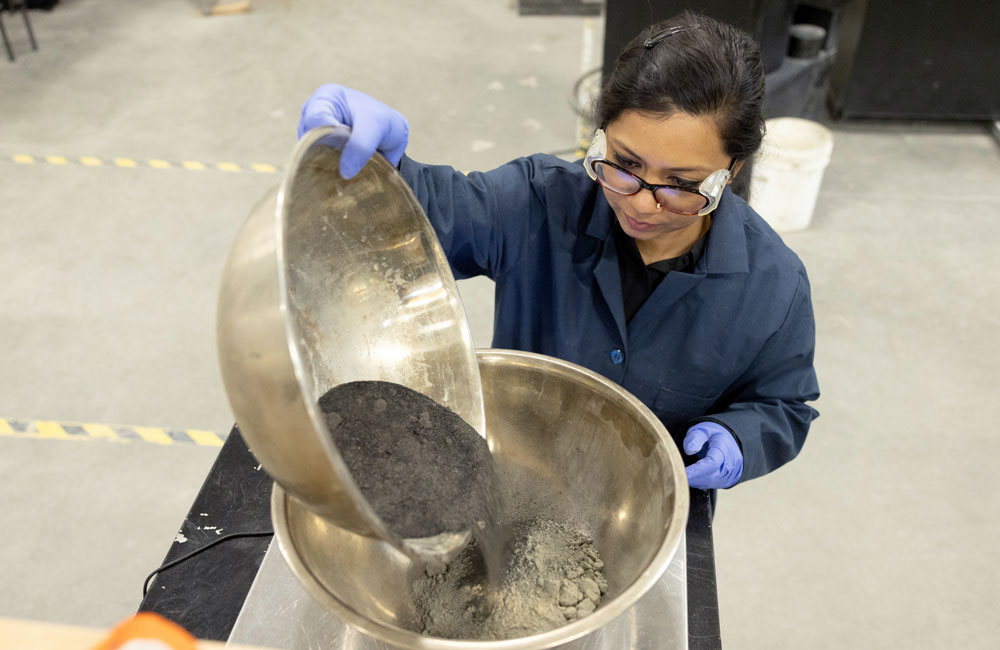
Rubaiya performing tests to find the optimum replacement level of cement with wood fly ash to produce green concrete.
How has your experience in the PhD program prepared you for your career or future academic goals?
The rigorous research training enhanced my analytical and problem-solving skills, while mentoring students and leading the Engineering Graduate Students Society strengthened my leadership, communication, and teamwork abilities. These experiences not only deepened my technical expertise but also prepared me for a career where I can balance research, teaching, and mentorship. Looking ahead, I aspire to continue advancing sustainable concrete technologies through both academia and industry research, contributing to innovative solutions that address real-world challenges while also guiding the next generation of engineers. The PhD program has given me the confidence and foundation to pursue this path and to make meaningful contributions to ensuring sustainability in concrete construction.
Have you had opportunities to present your research (e.g., conferences, publications, workshops)? If so, what have you learned from those experiences?
I had the honorable opportunity to present my research in various conferences among my expert colleagues in the Canadian Society for Civil Engineering (CSCE), the American Concrete Institute (ACI), and the Institute of Engineers Bangladesh. This exposure and the valuable comments and reviews from my peers and colleagues have been invaluable in carrying forward my research. Moreover, as a part of my fellowship from ACI, I get to attend the ACI conventions free of cost. These conventions are a gathering for the top researchers in my field, from whom I learn a lot. Furthermore, I published four articles in top journals of my field which are being cited by my fellow researchers. I also got an opportunity to present my work at the “UBCO Structures Talk” where I had the privilege to communicate with my colleagues from the University of Victoria doing similar research.

Capstone project team Solar Forge – Decarbonization of Melting/Recycling metal and Glass, winners of the sustainability category for the 2025 ENGR 499 Capstone Project Competition.
In an airplane hangar surrounded by WWII fighter jets and army helicopters, a life-sized, white robotic hand with what appears to be a computer chip on its finger juts out from a four-foot vertical metal beam, shaking uncontrollably. A group of people gather around, fascinated, as five engineering students explain how they designed and built a device that can monitor hand tremors in people with Parkinson’s disease.
This isn’t a glimpse into a classified defense prototype or a Silicon Valley tech reveal – it’s one of the 55 projects on display at the ENGR 499: Engineering Capstone Design Project Showcase & Competition at the KF Aerospace venue. This required course marks the culmination of every UBCO Bachelor of Applied Science student’s academic journey. But more than just a final assignment, Capstone is where theory collides with real-world expectations. Students don’t just apply what they’ve learned-they experience the full complexity of real-world engineering, from navigating ambiguous client needs to balancing technical constraints with user requirements.
Meet the Course and Instructors
ENGR 499, the Capstone course at UBCO, is a final-year design course required for all engineering students. It marks the magnum opus of students’ undergraduate education-challenging them to apply everything they’ve learned to solve real-world problems. It serves not just as an academic requirement but as a comprehensive test of professional readiness.
“Capstone is the first time many students realize that technical knowledge alone isn’t enough,” says Dr. Kenneth Chau, an associate professor in Electrical Engineering at UBCO and Capstone instructor for the past 5 years. “They’re suddenly working with clients, navigating team dynamics, and facing the kinds of ambiguity they’ll see every day in industry. “
Each year, approximately 350 students work on about 60 projects, ranging from medical devices and environmental solutions to aerospace technologies. Roughly 75% of these projects are industry-sponsored, 15% are submitted by faculty members, and about 10% are entrepreneurial ventures proposed by students themselves. When teaching Capstone, Dr. Chau adds, “The mindset I bring to the classroom is that we’re not just here to teach; we’re here to engage with society in ways that matter. If we don’t, we risk becoming irrelevant to the people we’re meant to serve.”
From collaborative industry engagements to the high-risk, high-reward nature of student entrepreneurship, Capstone offers a true blend of academic rigor, real-world complexity, and professional exposure.
Evolution of Capstone
Capstone at UBCO has evolved dramatically over time. “In the past, Capstone was primarily viewed as a technical challenge provided by an industry partner,” explains Dr. Chau. “But now, it’s about building meaningful relationships with stakeholders and engaging more deeply with the broader context of each project.”
This year, a new team selection process was introduced that includes a survey asking students to list people they do or do not want to work with, preferred projects, grade expectations, and their individual aptitudes, personalities, and working styles. An algorithm uses that data to form balanced teams.
“We’ve worked hard to mirror what real-world engineering looks like. Deliverables are now more structured, allowing for better engagement with external clients, and we’ve introduced peer evaluation mechanics to foster accountability among students. Peer scores directly affect individual grades, which encourages team members to hold each other accountable to a higher standard,” says Dr. Chau.
We’ve worked hard to mirror what real-world engineering looks like. Deliverables are now more structured, allowing for better engagement with external clients, and we’ve introduced peer evaluation mechanics to foster accountability among students.
Students now navigate a dynamic environment where timelines, budget constraints, and stakeholder expectations must be managed with professionalism. This mirrors industry expectations and fosters the soft skills necessary for career success.
Dr. Alon Eisenstein, an Assistant Professor of Teaching in Technology Entrepreneurship and Professional Development at UBCO, has been teaching ENGR 499 alongside Dr. Chau for the past two years. He echoes this sentiment: “It’s not just about increasing the level of industry involvement-it’s also about improving the quality of that involvement,” he notes. “We’re moving toward making student-faculty-industry interactions a required deliverable, ensuring that students are consistently engaging in meaningful dialogue throughout the project lifecycle.”
“Capstone projects are rarely confined to a single discipline. That’s intentional – real industry problems are inherently multidisciplinary. Success depends on how well students communicate, identify roles, and hold each other accountable,” Dr. Chau adds.
The goal is simple: to better prepare students for the professional world by simulating it as closely as possible within the Capstone structure, turning a final project into a transformative professional experience.
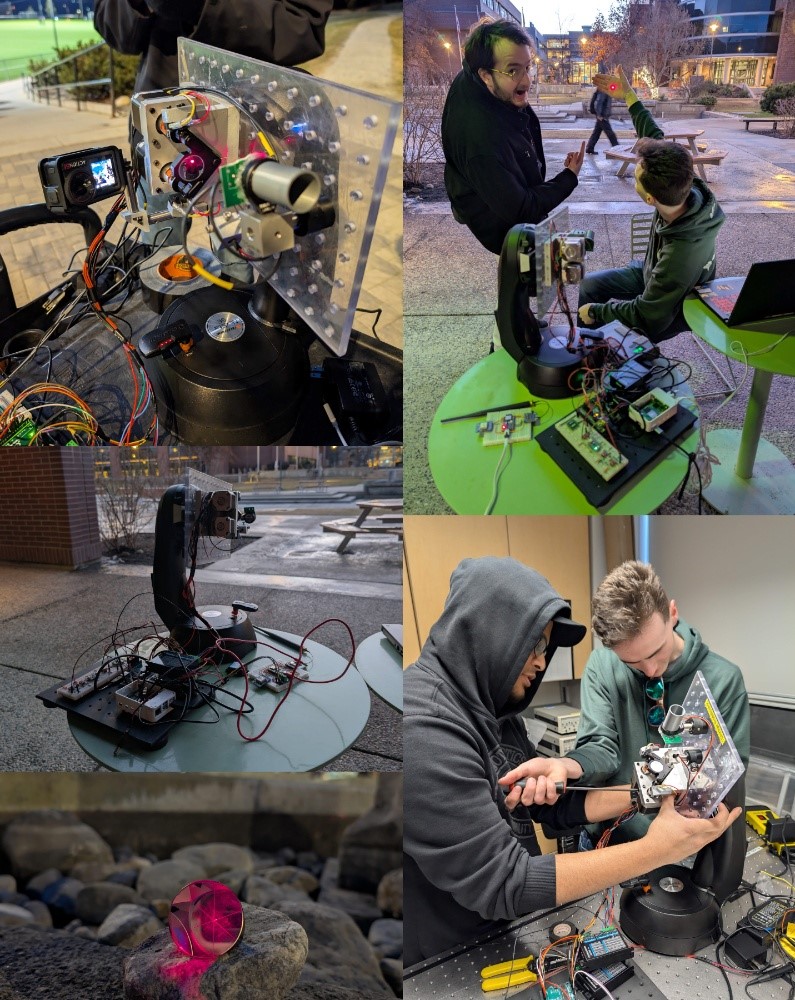
Capstone project team Targeting and Tracking System for Stratospheric Laser Links at various stages of development throughout their project. They designed a tracking system for stratospheric laser links.
Interdisciplinary Approach
UBCO’s Capstone is intentionally multidisciplinary-an approach that remains rare among Canadian engineering programs and increasingly vital as engineering becomes ever more collaborative.
“One of the strengths of our School of Engineering is that our students are trained to work across disciplines. Capstone reinforces that-it’s baked into the experience,” says Dr. Chau. “I often hear from industry that our alumni make excellent project managers because they’re used to collaborating with people from different backgrounds.”
One of the strengths of our School of Engineering is that our students are trained to work across disciplines. Capstone reinforces that-it’s baked into the experience.
In Capstone, engineering students from multiple disciplines work together in the same group, mirroring how real-world engineering projects unfold. Students learn firsthand how to leverage diverse expertise—and how to navigate the inevitable challenges of interdisciplinary communication and teamwork.
By fostering interdisciplinary collaboration, UBCO is preparing its graduates not just to succeed within their own specializations, but to lead diverse teams solving the complex problems of tomorrow.
Entrepreneurship in Engineering
Students are also encouraged to think like entrepreneurs-to go beyond building functional products and start thinking about scalability, marketability, and user-centric design.
“The entrepreneurial mindset isn’t about being broad or narrow—it’s about being user-focused and context-driven,” explains Dr. Eisenstein. “In Capstone, students have limited time-about seven months-and limited access to real users. So, I ask them: what solution can you design that’s broadly applicable and still effective? A Bachelor’s education trains generalists. A PhD creates specialists. The world needs both. But entrepreneurship lives in that space where solutions have to be good enough for many, rather than perfect for a few. That’s the kind of thinking we try to foster in Capstone. “
Whereas the School of Engineering typically provides $500 for each Capstone project, entrepreneurial teams can access up to $2,500 in funding through the CEWIL (Co-operative Education and Work-Integrated Learning) Canada’s iHub program with support by e@UBCO program, which provides not only mentorship and modules on impact but also clients and additional funding. That extra support is essential since these groups often lack the external funding that industry-sponsored projects benefit from.
“We’re especially committed to supporting student-led teams by ensuring they have mentorship and financial resources. For instance, last year’s winning team was student-led -they succeeded despite having no external sponsor, and that speaks volumes about the support system we’re building,” says Dr. Chau. “The students who thrive are those who understand how business works – how value is created and how to align engineering decisions with business goals. For some, that comes naturally. For others, Capstone is their first opportunity to develop that mindset.”
Real-World Readiness
Students quickly discover that real-world engineering demands more than technical know-how. Project management, client communication, teamwork, adaptability, and self-regulation are equally vital skills that can’t be developed overnight.
“Industry is becoming increasingly impatient with recent graduates, expecting them to be more ‘ready’ upon graduation-even though what ‘ready’ means can vary from one company to another. Students are expected to have basic technical skills like calculus and SolidWorks, but professional self-regulation is even more critical,” says Dr. Eisenstein. “It’s about having the initiative to learn, identifying gaps in knowledge, and building trust within a team rather than working in isolation.”
It’s about having the initiative to learn, identifying gaps in knowledge, and building trust within a team rather than working in isolation.
Both Dr. Chau and Dr. Eisenstein emphasize the importance of trust within teams. “The more trust there is within a team or organization, the more people are willing to engage in dialogue,” adds Dr. Eisenstein. “You’re more likely to admit what you don’t know, and others are more likely to support you when you do.”
Dr. Chau also says, “Effective teams often establish clear roles early, including someone dedicated to client communication. Poor-performing teams, on the other hand, tend to struggle with trust, commitment, and communication. We’ve found that traits like accountability and openness to conflict resolution are what really distinguish the high-functioning groups.”
Dr. Chau also highlights the growing importance of systems thinking-the ability to understand how different parts of a complex project interconnect and affect one another. “Breaking complex problems into subsystems and understanding how everything connects is key, especially in multidisciplinary environments,” he says.
Soft skills are no longer optional; they are central to engineering success, and Capstone ensures that students graduate with the technical mastery, professionalism, and interpersonal abilities needed to thrive as engineers.

Capstone project team Invasive Mussel Eradication: A Modular Solution (in no particular order): Rex Armor, Nathan Parmar, Pia Brar, Ben Neufeld, Tristan Simmons, and Usman Chughtai, who designed a portable system to eliminate invasive mussels.
Capstone’s Broader Impact
Both instructors see Capstone as a model for revamping engineering education at UBCO, where project-based learning can play a more significant role across all year levels.
“Capstone is essential for building professional identity and confidence-it’s the bridge between student and engineer,” Dr. Eisenstein reflects. “It’s where students truly begin to see themselves as professionals.”
Capstone is essential for building professional identity and confidence-it’s the bridge between student and engineer. It’s where students truly begin to see themselves as professionals.
“Ideally, by the time students reach Capstone, they’re already thinking this way-understanding the importance of external stakeholders, standards, and real-world constraints,” adds Dr. Chau. “We want to embed this mindset earlier in the curriculum as well. I’ve always seen academia and entrepreneurship as two sides of the same coin. When you engage with your community sincerely, they become your allies. They want to support you in solving real problems, and they become ambassadors for your work. “
Where To Next?
Ultimately, Capstone isn’t just the end of students’ undergraduate journey-it’s a launchpad into real-world engineering careers.
“The transition from school to work is a leap of faith for both students and employers,” says Dr. Eisenstein. “Companies don’t just hire based on technical expertise-they seek individuals who bring value, adaptability, and the self-awareness to grow in a professional environment.”
The transition from school to work is a leap of faith for both students and employers. Companies don’t just hire based on technical expertise-they seek individuals who bring value, adaptability, and the self-awareness to grow in a professional environment.
By weaving together technical expertise, entrepreneurial thinking, collaboration, and professional readiness, UBCO’s Capstone course transforms students from learners into industry-ready engineers-equipped not only to meet the challenges of today, but to lead the innovations of tomorrow.
Archisha Mahendru is a third-year Civil Engineering student with a big curiosity for how bridges and buildings come together, from the first sketch to the final structure. Her favorite hobby? Building or imagining things that don’t exist yet and finding a way to make them real.
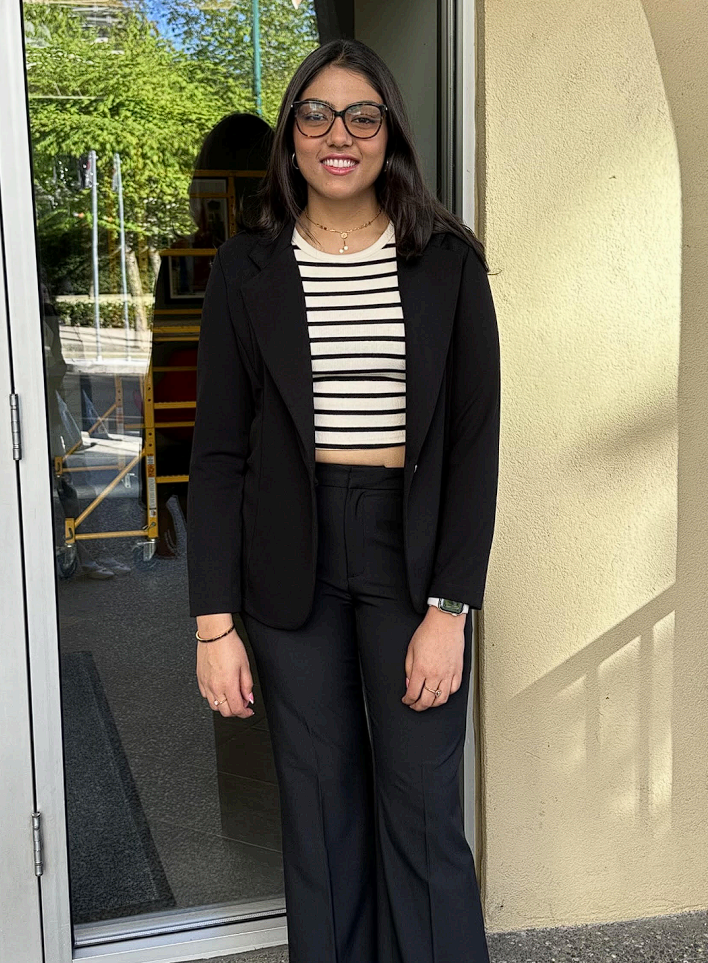
Archisha Mahendru, third-year Civil Engineering student at UBC School of Engineering.
Tell us a bit about yourself:
I’m currently a third-year Civil Engineering student with a deep passion for math, physics, and building things that last. Since I was a child, I’ve loved solving challenging problems and exploring how the world works, which naturally led me to engineering. I’m driven by curiosity and a desire to create something extraordinary, which is why I moved abroad to gain hands-on experience and broaden my perspective. For me, engineering isn’t just a career-it’s a lifelong dream and a way to make a real impact.
What drew you to UBC Okanagan and the School of Engineering?
I wanted to join UBC Okanagan because it offered the engineering major I’m passionate about pursuing. The university’s location in the beautiful, close-knit Okanagan Valley also appealed to me, creating a supportive environment for learning. Additionally, I’m excited about the research opportunities here, as they will help me explore different areas and decide which specialization within Civil I want to pursue for my master’s degree.
What has been the best part about being a UBCO Engineering student so far? If you could design a course or program to add to your degree, what would it be?
One of the most rewarding aspects of being a UBCO Engineering student has been the opportunity to participate in research and work as a structural engineering assistant. It was the first time I was able to move beyond theory and apply what I had learned in the classroom to real-world projects. Contributing to work that has a tangible impact was both exciting and challenging, and it gave real meaning to everything I was studying.
Another highlight was attending SOE networking events. While the free food was definitely a bonus, what stood out most was meeting industry professionals who once sat in the same lecture halls as us. Hearing their stories and advice was incredibly motivating and reminded me that every successful journey starts with a single step-or a tough midterm.
Contributing to work that has a tangible impact was both exciting and challenging, and it gave real meaning to everything I was studying.
If I could introduce a new program to our degree, it would be a bridge-building competition using raw materials like popsicle sticks, string, or even spaghetti. It would give students a creative and practical way to apply engineering concepts outside the classroom while encouraging teamwork, innovation, and a bit of friendly competition. Activities like this not only reinforce technical skills but also help build a stronger, more connected engineering community.
On the flip side, what has been the most challenging aspect of university so far? How has your perspective on perseverance evolved because of it, and what lessons did you learn?
One of the most challenging parts of my university journey has been balancing a part-time research position with a full course load-all while somehow ending up with the most intense exam schedules imaginable. With back-to-back exams, assignments, and labs, it often felt like a constant test of time management and emotional resilience.
Through this, my understanding of perseverance has evolved. I used to think it meant powering through at all costs-surviving on caffeine and last-minute cramming. But over time, I’ve learned that true perseverance is about consistency, planning ahead, and knowing when to ask for help.
If there’s one piece of advice I’ve taken to heart, it’s this: don’t wait for the “perfect” time-because it doesn’t exist. Start early, stay curious, and make time to enjoy university life. And most importantly, learn from the people around you-classmates, professors, even strangers. Everyone has something valuable to teach you if you’re open to listening.
Why did you choose to study engineering? How do you envision engineering shaping your life personally and professionally in the future?
Becoming an engineer has been a lifelong passion of mine. Ever since I was a child, I’ve been drawn to math and physics, often solving problems just for fun. I especially enjoyed the most challenging questions my teachers would give me as they pushed me to think critically, creatively, and to keep learning.
More than just a career path, engineering is something I’ve envisioned and worked toward my whole life. Personally and professionally, I hope to use my skills to create positive change, specifically by designing affordable housing for underprivileged communities and building essential infrastructure like bridges in regions with limited resources. For me, engineering is a way to turn curiosity into compassion and ideas into lasting impact.
What is one thing most people don’t know about you?
Most people don’t know that I absolutely love food-especially ramen! I love trying different kinds of food and exploring new places to eat. I’m also really into fitness, and going to the gym is one of my favorite ways to destress. On weekends, I love taking road trips and discovering new spots. After long days of studying and problem-solving, these things help me relax and keep life fun outside of academics.
Who or what inspires you? Have you had a mentor before, and if so, what did they help you learn about yourself?
I’m inspired by the people around me-especially my peers and professors. Seeing how hard they work, juggle assignments, research, and everyday responsibilities, it really motivates me. They’re managing so much and still pushing forward, and it makes me think: “If they can do it, I can too.” Their dedication and resilience remind me that challenges are a part of the journey, and that perseverance isn’t about doing everything perfectly-it’s about showing up and doing your best, even on the tough days.
Perseverance isn’t about doing everything perfectly-it’s about showing up and doing your best, even on the tough days.
Other than this I’m here because of my parents. Their constant support, sacrifices, and belief in me made it possible for me to study at UBCO, and that’s something I’m deeply grateful for. My parents have supported me at every step of my life, and whatever I am today is because of them. Knowing how much they’ve done for me is one of the biggest reasons I stay motivated each and every day. I feel proud and happy to be on this journey, not just for myself, but for them too.
How has engineering changed your view on the world? What misconceptions do you think the public holds about engineering, and what would you do to change those perceptions?
Engineering has completely changed how I see the world. Now, I notice the design and thought behind everything-from bridges to water systems-and I realize how essential engineers are in making our daily lives safe and functional. I honestly can’t imagine the world without them.
A common misconception is that engineering is only for people who are naturally gifted in math or science. In reality, it’s about creativity, teamwork, and problem-solving. To change that view, I think we need more outreach that highlights the human side of engineering, including real-world projects, student work, and the impact engineers have on communities.
In 5 words or less, how would you sum up the UBCO / School of Engineering experience?
I have three options!
- Coffee-fueled chaos with purpose.
- Engineering: where fun meets formulas.
- Hard hats, harder exams (and) memories.
What is one thing you know now that you wish you would have known in high school, in first year, or in an earlier moment in your life? If you could give your future self one piece of advice, what would it be?
Looking back, I wish I had known more about the opportunities available early on—especially as an international student. If I had done AP courses in high school, I could’ve transferred some credits and had more flexibility in my degree. In my first year, I was still adjusting to a new environment and trying to meet people, so I missed out on things like research opportunities and club applications just because I didn’t know when or how to get involved.
If I could give advice to first-year students or to my past self, I would say be open to everything. Don’t limit yourself. This is the time to meet new people, build connections, join competitions, talk to professors, and explore different paths. Don’t hesitate to ask questions or try something new-even if it feels a little intimidating. You never know what opportunity or connection might shape your journey.
What project or experience at UBCO has made you feel particularly proud or like a “real” engineer so far?
One experience that truly made me feel like a “real” engineer was working on my research project in the Transportation Lab at UBCO. I loved being part of a team where I could analyze real-world data and contribute to work that had a tangible impact. The most rewarding part was seeing a project I worked on actually get implemented. It was a powerful reminder that the work we do in the lab doesn’t just stay on paper.
Digging into the data, identifying patterns, and understanding how our research could shape real transportation systems made the experience incredibly meaningful. It showed me how impactful engineering can be when applied thoughtfully, and it deepened my passion for solving practical problems that make everyday life better for others.
With six courses per semester, balancing the technical demands of your degree can be tough. How do you manage to maintain a healthy work-life balance and meet the demands of your personal life?
I’ve taken six courses every semester, and I won’t lie, it was definitely tough at first. In the beginning, I struggled to balance everything, but over time I found a rhythm that worked for me. I started doing meal prepping to save time during the week, which helped a lot with staying healthy and less stressed. I also made it a priority to go to the gym around four days a week. It was my way of taking a break, staying active, and clearing my mind. Maintaining a work-life balance in engineering isn’t easy, but I learned that small habits and routines make a big difference. Planning ahead, taking breaks, and making time for yourself, even just a little, helps you stay focused and avoid burnout.
What advice do you have for future/current engineering students?
My advice to future and current engineering students is: take advantage of every opportunity early on. Go to the networking events that SOE organizes-they’re a great way to meet industry professionals, learn about different career paths, and get inspired.
Look for on-campus jobs related to your degree, and don’t hesitate to ask professors about volunteering in their labs.
Working alongside graduate and PhD students is a great way to gain experience and insight into real-world research. Also, encourage your friends to get involved to keep each other motivated and share opportunities. Engineering can be intense, but having a strong support system and staying proactive makes a huge difference. The more you put yourself out there, the more doors you’ll open for your future.
Anything else you’d like to share about your UBCO Engineering student journey?
One thing I’d love to share about my UBCO Engineering journey is the amazing people I’ve met along the way. From spontaneous road trips to living with friends and sharing countless laughs during late-night study sessions, the memories we’ve created are ones I’ll never forget. These friendships have become some of the most meaningful parts of my university experience. What I’ve learned outside the classroom has been just as valuable as everything I’ve learned inside.
What I’ve learned outside the classroom has been just as valuable as everything I’ve learned inside.
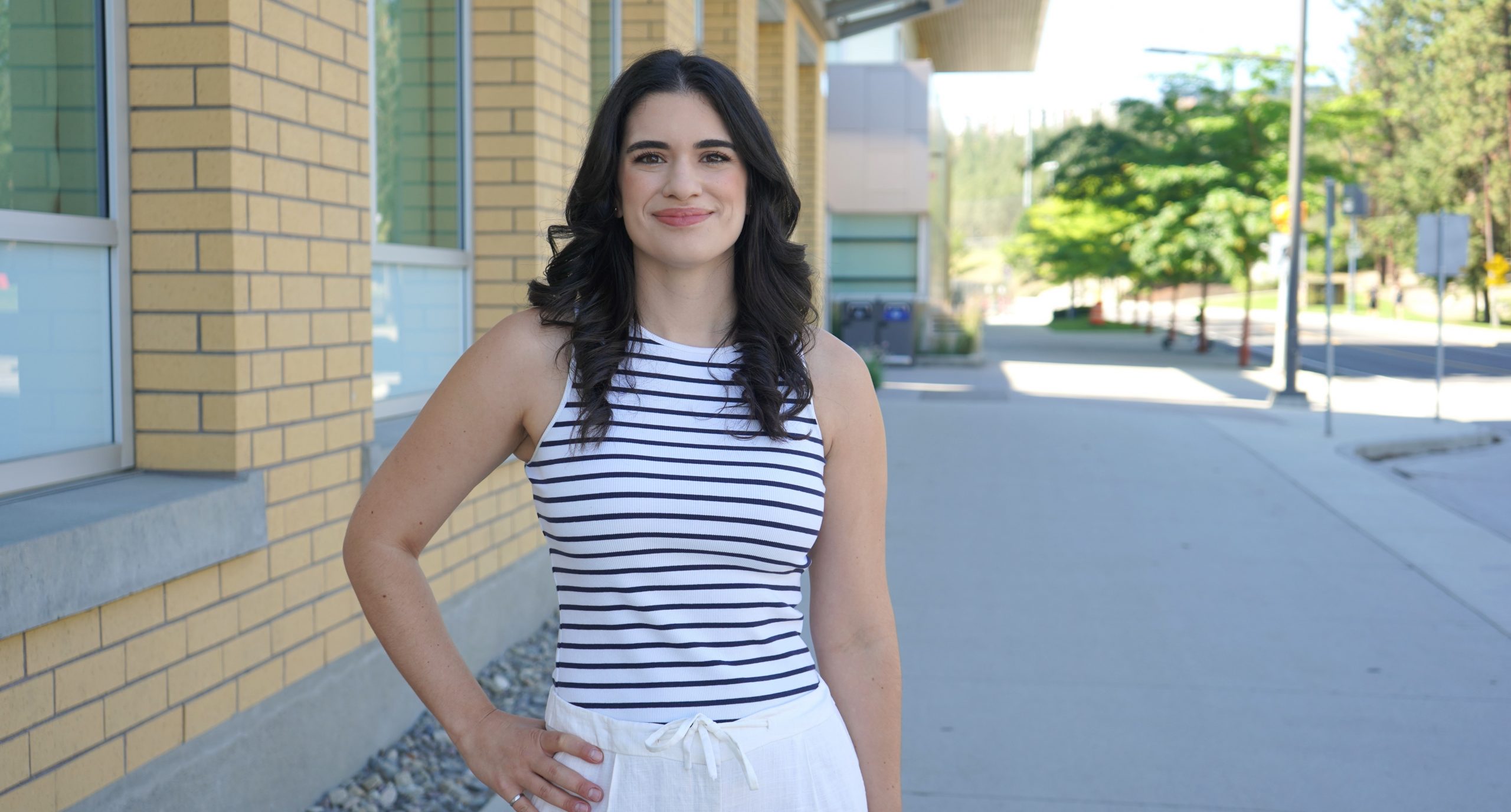
Dr. Jennifer Frattolin outside the EME building.
Dr. Jennifer Frattolin is an assistant professor in mechanical engineering specializing in biomedical engineering. In recognition of International Women in Engineering Day, she is one of several women in engineering being spotlighted from the School of Engineering.
What sparked your interest in engineering? Can you share a moment when you knew this was the path for you?
I was always fascinated by the human body and how it works; when I was younger, I thought this meant I was supposed to become a doctor. Instead, when I was exposed to the subject of biomedical engineering in my high school biology class, I realized engineering was the career path for me. In my grade 11 biology class, we did a special topic on artificial heart design – now, much of my research over the past 12 years has been focused on medical devices and the circulatory system.
What drew you to UBC Okanagan, and what has made this campus feel like home for research, teaching and life?
Having worked and lived in large urban centres for the past 11 years, including Montreal and London, UK, I wanted my next academic position to be at a smaller institution. I have always wanted to be part of a university where I could have a significant impact, both with respect to my research and teaching. UBC Okanagan is the ideal university to achieve these goals, as a research-intensive institution with a close-knit academic community.
I have always wanted to be part of a university where I could have a significant impact, both with respect to my research and teaching. UBC Okanagan is the ideal university to achieve these goals, as a research-intensive institution with a close-knit academic community.
Tell us about your research.
My research is focused on building microfluidic models of the immune system to study its role in health and disease. Microfluidic chips are miniaturized devices with a network of micro-channels that can move small quantities of fluid and cells. I design custom chips that uniquely replicate the tissue micro-environment. Currently, I am working on building a chip model of a coronary artery to study how the immune system plays a role in cardiovascular disease.
What does a typical day in your research world look like? How do you conduct your research?
My research is largely experimental. I love working in the lab and running experiments, so I am always looking for time in my schedule to do this work. My dedicated research time is typically split between writing research papers and grants and working in my lab.

T and B cells in a hydrogel.
Why does your research matter? What kinds of change or impact do you hope it will bring to the world?
The immune system is the body’s defense against disease and infection, and there is still so much we do not understand about it. Next generation immunotherapeutics, drugs that tune the immune system to fight diseases such as cancer, require us to have an in-depth understanding of how the immune system works in different disease contexts. My research is focused on improving our understanding of the immune system’s complexity and identifying exploitable targets for drug development, a critical part of developing novel therapeutics to treat diseases such as cancer and cardiovascular disease.
What do you love most about teaching and how has being in the classroom shaped your own understanding of engineering?
I am fortunate to teach subjects that I am truly passionate about such as biomedical engineering and material science. It is incredibly rewarding to see students make complex connections between engineering and biology to investigate real-world problems, such as designing tissue engineered scaffolds. Being in the classroom has consistently challenged me to refine complex engineering concepts into their most essential and understandable forms. More importantly, it has encouraged me to view the field of engineering through the lens of the student, who often ask questions that challenge assumptions in my field.
How do your roles as a researcher and an educator intersect in surprising or rewarding ways?
One of the courses I teach, Tissue Engineering, is closely related to my own research. I weave into the lectures cutting-edge, real-world examples from my own research, which I believe enriches the overall learning experience for the students. One of the most rewarding aspects of this is when students approach me after class to learn more about my research and seek opportunities in my lab.
One of the most rewarding aspects of this is when students approach me after class to learn more about my research and seek opportunities in my lab.
As we approach International Women in Engineering Day on June 23, 2025, we asked Jennifer to reflect on her experiences as a woman in engineering.
As a woman in engineering, how has your perspective shaped your experience or purpose in the field, and what shifts are you seeing today?
I think it is incredibly important to have female faculty role models for both undergraduate and graduate students. As a mechanical engineering student, I had very few female role models in the field and that challenged my perception of belonging. Now as an assistant professor in mechanical engineering, I strive to be accessible to our female engineering students and support them in their journey to become engineers- so they can continue to break down barriers in STEM and achieve success.
Are there women in engineering whose work or journey has inspired your own?
Dr. Meilan Liu was a professor at Lakehead University where I pursued my Bachelors of Engineering. She was an inspiration to me – she was the only female professor in mechanical engineering, and she made me realize that I too could become a professor one day. Knowing I wanted to pursue a similar path into academia, I looked up to her and sought her mentorship, particularly in my final year of my undergraduate studies while I was navigating graduate school applications and my Capstone project, where she served as my advisor.
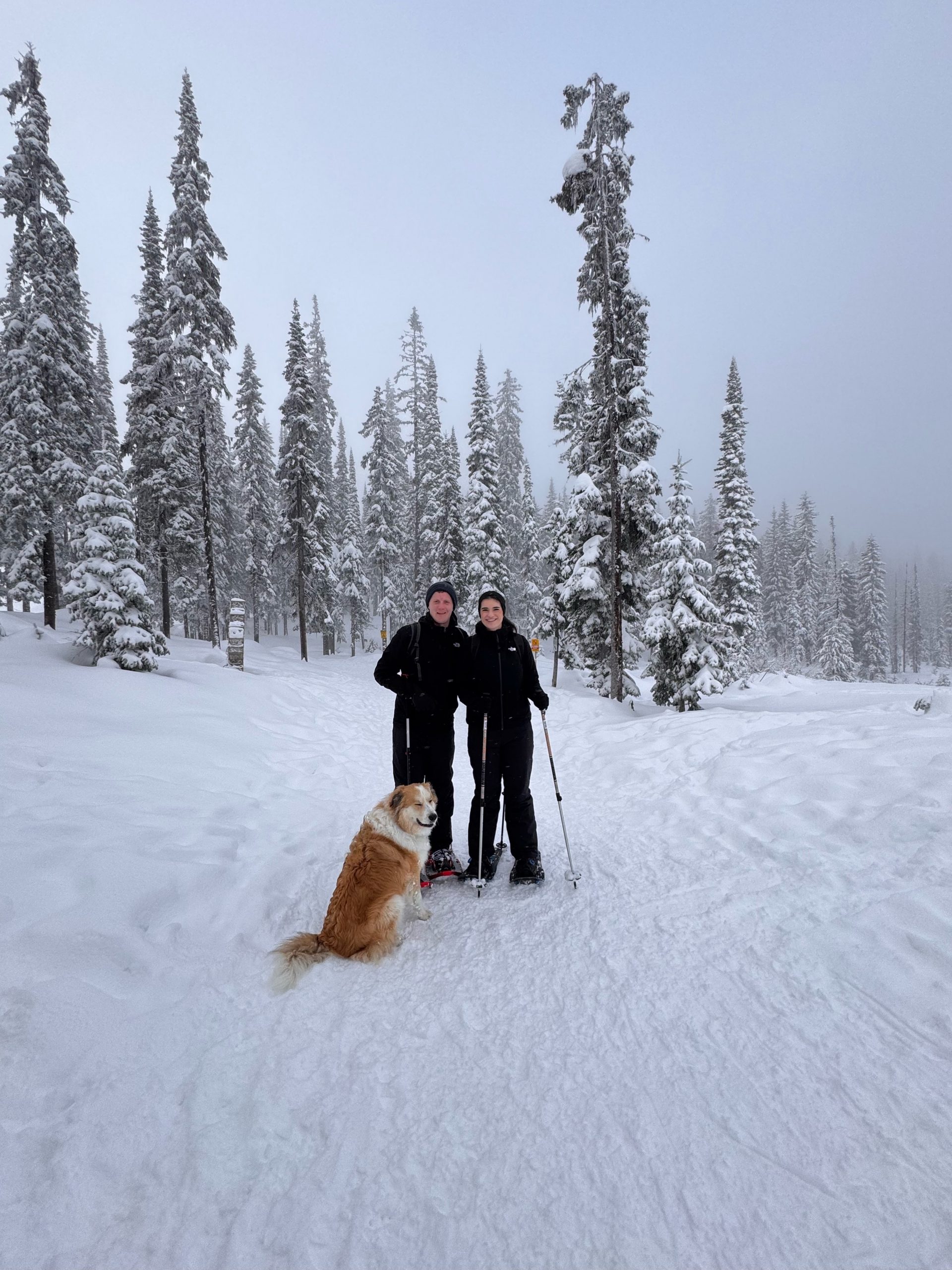
Dr. Frattolin and her husband at Big White.
What advice would you share with the next generation of women and underrepresented voices entering engineering?
Be authentic to yourself and take up space. Your voice matters. Anyone can become an engineer if they put in the hard work and have the right attitude.
Anyone can become an engineer if they put in the hard work and have the right attitude.
What’s lighting you up this summer-whether it’s a new idea, exciting project, or something outside of work?
I am new to the Kelowna area having moved to British Columbia in July of last year. I am excited to explore the surrounding Okanagan this summer. My husband and I love to hike, so I am looking forward to experiencing the beautiful trails around Kelowna.