jputhe01

Email: janaki.putheth@ubc.ca


Meet UBCO Steel Bridge: They are a student-led engineering design team from the University of British Columbia Okanagan. Founded in 2023, the team made history as the first annex-campus team in Canada to compete independently at the Canadian National Steel Bridge Competition. The team focuses on structural efficiency, sustainability, and hands-on fabrication, giving students the opportunity to apply classroom concepts to real-world challenges. Driven by collaboration and innovation, the team continues to grow as a cornerstone of UBCO’s engineering community.


Photo of UBCO Steel Bridge team at CNSBC 2025

Photo of UBCO Steel Bridge team at Canadian National Steel Bridge Competition 2025


Tell us about your team.

We’re a group of civil engineering students who came together with a shared goal: to build something real. The UBCO Steel Bridge Team was founded to give students at our campus the chance to apply what we learn in class to hands-on design and fabrication. Most of us had never welded or designed a bridge before joining, so we learned everything from the ground up, together.

Our work spans the entire lifecycle of the bridge: structural analysis, 3D modeling, design optimization, budgeting, fundraising, fabrication, and competition logistics. Every piece of the bridge—from the first sketch to the final bolt—is student-led and team-built.

What makes our team special is the culture. We’re collaborative, resourceful, and not afraid to figure things out as we go. From late nights in the shop to early morning design reviews, everyone shows up not just to work but to support each other. Whether you’re on the design, build, logistics, or outreach side, you’re part of a team that values effort, growth, and passion.

Whether you’re on the design, build, logistics, or outreach side, you’re part of a team that values effort, growth, and passion.

How did your team get started or grow over time?

The UBCO Steel Bridge Team started with just a handful of students who saw a gap — there were plenty of design competitions out there, but nothing at our campus that focused on structural engineering in a hands-on way. So we decided to build it from the ground up. No existing framework, no blueprint — just motivation, Google Docs, and a lot of trial and error.

Our first year was about proving that we could do it. We designed, fabricated, and competed as an independent team at the Canadian National Steel Bridge Competition — the first time a satellite campus from Canada had ever done so. From there, word spread and interest grew. What started as a small group turned into a fully structured team with subgroups for design, build, logistics, and outreach.

We’re still growing, but every step has been about laying a foundation — not just for competition success, but for building a sustainable, student-led team that future engineers at UBCO can carry forward.

What kinds of projects or competitions has your team been involved in?

Our team’s primary focus is the Canadian National Steel Bridge Competition, a national-level event where university teams are challenged to design, fabricate, and construct a scale-model steel bridge. The competition emphasizes structural efficiency, construction speed, cost-effectiveness, and compliance with strict design constraints. It’s a comprehensive test of engineering knowledge, teamwork, and hands-on problem-solving.

In addition to the competition, we’re actively involved in outreach initiatives, industry engagement, and skill development workshops. We also dedicate time to internal projects that improve our processes – from refining our fabrication techniques to experimenting with more efficient connection designs. These efforts help us grow not just as competitors, but as a learning-focused and sustainable team.
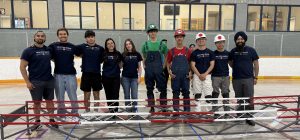
UBCO Steel Bridge at CSBC

UBCO Steel Bridge at CSBC

“These efforts help us grow not just as competitors, but as a learning-focused and sustainable team.”

What has been one of your team’s proudest accomplishments so far?

There are a few milestones we’re especially proud of. First, growing the team from just a few students into a structured and motivated group has been a huge achievement on its own. Starting from almost nothing, we built a foundation for something sustainable. Seeing more students step up, take ownership, and bring new energy into the team has been incredibly rewarding.

We’re also proud of the strong relationships we’ve built with industry partners. Securing meaningful sponsorships and support from professionals in the field not only validated the work we’re doing, but helped us bridge the gap between student learning and real-world engineering.

And finally, being recognized with the Most Improved Team award at the 2025 Canadian National Steel Bridge Competition was a proud moment. It was a reflection of all the hard work, long nights, and collective effort that went into turning an ambitious idea into something real.

“It was a reflection of all the hard work, long nights, and collective effort that went into turning an ambitious idea into something real.”

What was a challenge you had as a team and how did you overcome it?

One of our biggest challenges was navigating the steep learning curve that came with starting from scratch. None of us had prior experience designing or fabricating a steel bridge, and we didn’t have an established playbook to follow. Everything, from structural design and welding to budgeting and logistics, had to be figured out through trial, error, and a lot of persistence.

What got us through was our willingness to ask for help, stay adaptable, and support one another. We reached out to professors, industry mentors, and even other teams to learn from their experiences. More importantly, we built a culture where it was okay to not have all the answers, as long as we were willing to learn. That mindset helped us move forward, one challenge at a time, and turn obstacles into stepping stones.

UBCO Steel Bridge Team showcasing their list of sponsors

UBCO Steel Bridge Team showcasing their list of sponsors

How do you think student design teams contribute to the UBCO engineering experience overall?

Student design teams add a whole new layer to the engineering experience at UBCO. They take what we learn in class and push us to apply it in real, hands-on situations. From technical design to working under pressure, it’s one thing to study theory, and another to actually build something from the ground up.

At a smaller campus like UBCO, these teams also create tight-knit communities. You’re not just learning — you’re leading, collaborating, and figuring things out together. It gives students a sense of ownership and purpose that really strengthens both their skills and their confidence.

What was one of your team’s best memories’ while working together?

One of our favorite memories was the night before our presentation at the 2025 competition. Our entire team was crammed into one small hotel room, laptops out, sitting on the floor, beds, and anywhere we could find space. We were putting the final touches on our presentation, rehearsing lines, adjusting slides, and giving each other feedback.

It was chaotic in the best way. Everyone was tired, but completely dialed in. That moment really captured what our team is about, showing up for each other, figuring things out together, and having fun even under pressure. It felt less like a task and more like a group of friends doing something we all cared about.

What advice would your team give to students thinking about joining or starting a design team?

Don’t wait until you feel “ready”, just start. Whether you’re joining an existing team or thinking about starting your own, the most important thing is to take that first step. You don’t need to have all the technical knowledge figured out, you’ll learn as you go. What matters more is showing up, being willing to try, and working together with others who care.

“Don’t wait until you feel “ready”, just start.”

For those starting something new, know that it won’t be perfect at the beginning — and that’s okay. Focus on building a strong culture, finding good people, and staying consistent. The rest will come with time. Looking back, some of our best progress happened when we were figuring things out in real time, and doing it together.

Anything else you’d like to share?

Next year is going to be big for us. We’re aiming higher, from improving our structural performance and build speed, to refining our fabrication methods and making our design more innovative and sustainable. After everything we learned from our first year, we’re coming back more focused, more prepared, and more ambitious than ever.

But beyond the competition, we’re also working on growing the team, strengthening our industry connections, and creating more opportunities for students at UBCO to get involved in hands-on engineering. Whether that’s through workshops, mentoring, or community outreach, we want to make the design team experience accessible to more people.

So keep your eyes on us! We’ve got some exciting things in the works, and we’re just getting started. If you’re someone who’s curious, motivated, or just wants to build cool stuff with a great team, come find us. There’s a place for you here.

Curious about the UBCO Steel Bridge Team? Visit their website to learn more: https://www.ubcosteelbridge.ca

 

Mojdeh standing outside smiling.

Mojdeh Rezaei-Khamseh, Master of Applied Science Student at UBCO.

Meet Mojdeh Rezaei-Khamseh: a Master of Applied Science (MASc) international student in Mechanical Engineering at UBC Okanagan and recipient of the 2025 Dr. Spiro Yannacopoulos International Engineering Student Memorial Award. Mojdeh’s research explores the use of electrospun plant-based materials enhanced with conductive and magnetic fillers to design multilayer structures with high absorption capabilities. With a background in both polymer science and hands-on experimental techniques, Mojdeh brings an interdisciplinary approach to solving environmental and technological challenges. She is passionate about advancing green materials for energy efficiency.

It was Mojdeh’s passion and potentional to contribute greatly to her chosen research field, strong academic performance, and engagement with the UBC community that made her the worthy recipient of the 2025 Spiro Award. In recognition of International Women in Engineering Day, she is one of several women in engineering being spotlighted from the School of Engineering.

Tell us a bit about yourself.

I’m an international graduate student with academic and professional experience across three countries. I completed my first Master’s degree in France, where I specialized in polymer composites and gained industrial experience working on their mechanical characterization. Now, at UBC Okanagan, I am continuing my journey in materials research with a focus on green technologies and sustainable composites. Outside the lab, I’m also passionate about fashion and jewelry making, which nurtured my precision and creativity, skills that carry over into my research.

Tell us about your academic journey leading up to your MASc studies.

My academic path began with a Bachelor’s in Materials Engineering in Iran. I then pursued a Master’s degree in France, where I gained hands-on research and industry experience in polymer-based composites, especially their mechanical performance. These experiences laid the groundwork for my current research interests. Coming to UBCO has allowed me to combine that foundation with innovative nanotechnology and sustainability goals.

What inspired you to pursue a Master of Applied Science degree, and why did you choose UBC Okanagan for your graduate studies?

After gaining research and industry experience, I realized I wanted to take a more research-intensive path to explore sustainable materials. The MASc program at UBC Okanagan offered the perfect balance of hands-on lab work, advanced facilities, and a focus on real-world impact. Dr. Arjmand’s group stood out for its cutting-edge work on nanocomposites and electromagnetic shielding, aligning closely with my interests and background.

“The MASc program at UBC Okanagan offered the perfect balance of hands-on lab work, advanced facilities, and a focus on real-world impact.”

Tell us about your research.

We’re constantly surrounded by electronics that emit invisible electromagnetic waves. These waves can interfere with one another and even pose safety risks. My research focuses on making a special fabric-like material from lignin (a natural byproduct from plants) that absorbs these waves instead of reflecting them. Over 5 billion kilograms of lignin are burned every year as waste, and we’re working to valorize it, that is, transform it into something valuable and functional. It’s like creating a biodegradable noise-cancelling blanket for electronics, which is light, flexible, and eco-friendly.

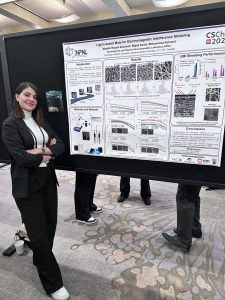
Mojdeh at a conference beside her research

Mojdeh at a conference beside her research.

What has been the most rewarding part of your UBCO experience?

For me, it’s been the opportunity to work in a collaborative and well-equipped research environment. From designing experiments to analyzing results and sharing them at conferences, every step has helped me grow as a researcher. The mentorship and peer support have been especially valuable. I’ve also worked alongside incredibly experienced peers and received invaluable mentorship from my supervisor and senior lab members, especially when I was new to UBCO. I’ve been involved in programs like WISE (Women in Science and Engineering), first as a committee member and soon, I hope, as a mentor; this sense of community has made a huge difference.

What challenges have you faced during your time at UBC, and have you grown or adapted as a result?

Adjusting to a new academic environment in Canada after studying in France and Iran came with its own learning curve. Balancing coursework, research, and personal life, especially as an international student, was challenging. But it has made me more independent, confident, and adaptable in both academic and personal dimensions. Joining campus associations and volunteer programs like Let’s Talk Science helped me integrate, build leadership skills, and connect with others; even mentoring kids through science activities was a joyful and empowering experience.

What advice would you give to prospective or incoming UBCO students?

Stay curious and proactive. Don’t be afraid to approach professors or seek help. Take full advantage of the facilities and interdisciplinary opportunities. Joining campus associations and volunteer programs like Let’s Talk Science helped me integrate, build leadership skills, and connect with others; even mentoring kids through science activities was a joyful and empowering experience.

“Your initiative will define your experience more than anything else.”

How has your experience in the MASc program prepared you for your career or future academic goals?

The MASc program has sharpened my technical skills in areas like electrospinning, material characterization, and nanocomposite fabrication. More importantly, it’s trained me in critical thinking, scientific writing, and independent research. I now feel well-prepared for either a research-driven industry role or further academic study at the PhD level.

Have you had opportunities to present your research (e.g., conferences, publications, workshops)? If so, what have you learned from those experiences?

Yes, I’ve presented my work at multiple conferences, including a poster session at the UBC Bioproducts conference and the CCEC (Canadian Chemical Engineering Conference) in Toronto. I’m also in the final stages of preparing a manuscript for submission to the Advanced Functional Materials journal. The paper focuses on my project of lignin valorization. Presenting has helped me improve my ability to explain complex research clearly and confidently both to experts and non-specialists.

If you could give your past self one piece of advice before starting your MASc journey, what would it be?

Trust your pace and process. It’s okay not to have all the answers right away. Research is about discovery, persistence, and continuous improvement.

“Trust your pace and process. It’s okay not to have all the answers right away. Research is about discovery, persistence, and continuous improvement.”

Is there anything else you’d like to share about your experience as a graduate student in engineering?

Graduate school is as much about self-growth as it is about academic achievement. It’s a chance to challenge yourself, think critically, and build a foundation for impactful work, especially in fields like sustainable engineering, where the world truly needs innovative minds.

As we approach International Women in Engineering Day on June 23, 2025, we asked Mojdeh to reflect on her experiences as a woman in engineering.

As a woman in engineering, how has your perspective shaped your experience or purpose in the field, and what shifts are you seeing today?

As a woman in engineering, I’ve felt the challenges deeply—often to the bone—at every stage of my academic life. These experiences have shaped not just how I navigate the field, but also how I support others within it. I’ve served as a committee member for the Women in Science and Engineering (WISE) program at UBC Okanagan and have actively volunteered for numerous women-led initiatives such as Dress For Success. Through these roles, I’ve witnessed both the systemic barriers and the strength of community-driven progress. Encouragingly, I’ve also observed a gradual cultural shift, more inclusive spaces, more visibility for women, and growing momentum for change.

Are there women in engineering whose work or journey has inspired your own?

Definitely, one of my role models is Anousheh Ansari, an engineer and the first Iranian woman in space. Her journey from a young girl passionate about the stars to a spaceflight engineer who actually fulfilled that dream has resonated with me on a personal level; I’ve always loved astronomy and deeply miss my telescope. These women remind me that no dream is too distant when pursued with determination.

What advice would you share with the next generation of women and underrepresented voices entering engineering?

Own your story and never underestimate your potential. There will be moments when the path feels isolating or unfair, but you are not alone. Surround yourself with those who uplift you, find mentors, and don’t be afraid to speak up. Your presence in engineering is not only valid, it’s essential to shaping a better, more equitable future in science and technology.

“Your presence in engineering is not only valid, it’s essential to shaping a better, more equitable future in science and technology.”

Conor Manahan is a civil engineering student originally from Victoria, BC. With a passion for hands-on problem-solving and the outdoors, civil engineering was a natural fit for him. Named as the 2025 Head of Class, he plans to continue working with the District of Lake Country while pursuing his P.Eng designation.

A headshot of Conor.

Conor Manahan, Head of Class

Tell us a bit about yourself:
I was born in Victoria, BC, played lacrosse at a high level, and am very passionate about the outdoors. I live in Lake Country now with my wife Cydney, and we both look forward to starting the next chapter of our lives. 

What drew you to UBC Okanagan and the School of Engineering?

I’ve always been interested in engineering and am an avid outdoorsman, so being in the Okanagan allowed me to pursue both my passions. We do a lot of camping, and I’m big into hunting and fishing, the wilderness is basically at our doorstep, and we can be out on a forest service road in 15–20 minutes. My dad and brother often come up too, it’s kind of a family thing.

Originally, I started off studying chemical engineering at McGill while playing lacrosse, but at 18 in Montreal, there was maybe a bit more socializing than schooling. I didn’t enjoy it, so I came back home and worked in road construction for a while. My mom, who works for the province, mentioned the civil program, and that got me intrigued. I ended up starting in the civil tech program at Camosun College and eventually bridged to UBC.

What was the most rewarding aspect of your time at UBCO?
The most rewarding aspect of my time at UBCO was seeing that hard work and a good group of friends had tangible outcomes in success. Honestly, I couldn’t have done it alone. Having that crew to push each other and share the load made a huge difference, and seeing that pay off made the whole journey feel worth it.

The most rewarding aspect of my time at UBCO was seeing that hard work and a good group of friends had tangible outcomes in success. Honestly, I couldn’t have done it alone.

What role did community—classmates, mentors, or campus life—play in your journey?

I was fortunate enough to have a close group of friends that all took many of the same classes. We were able to push each other and help each other through the program, and it was critical in all our success. Specifically, in between classes, we’d grab a table at the EME building and just grind through whatever work we had. We’d bounce ideas off each other, challenge each other with questions, and really get into it. That was a huge part of how we kept going, especially with such a heavy workload. A lot of us were transfer students, so we kind of found each other naturally, and it helped ease that “new kid” feeling when jumping in mid-program.

Did you participate in co-op, undergraduate research, or other hands-on experiences? How did they shape your path?

 I paved roads in between semesters in my first two years of engineering and was employed as an engineering student from the end of my third year throughout my fourth year. That student role was actually a precursor to my current full-time job with the District of Lake Country. I did a lot of asset management, stayed on part-time during school, and it all rolled into a smooth transition afterward.

The real-world experience from both construction and engineering work helped me connect theory to practice. Things like transportation courses, water conveyance, even project management,those gave me context for what I do day-to-day now. I remember one interview where I brought up the idea of being proactive vs. reactive, which I picked up in a class, and it turned out to be exactly what they were looking for.

There is no doubt that achieving top grades in your graduating class was hard work! Can you talk about a moment when you were really challenged academically—and how you overcame it?
To graduate sooner and accept a full-time employment opportunity, I took 7 courses in my final semester. It was a challenge to balance the workload, but I had a friend doing the same thing and we were able to hold each other accountable and help each other where necessary.

As this year’s Head of Class, can you tell us about a particular project, professor or course that had a lasting impact on you? Why?
I really enjoyed all of Dr. Ahmad Rteil’s classes and his teaching style. His classes were challenging yet rewarding, and his engagement in each lecture was, in my opinion the best way to learn. He didn’t just lecture with slides,he’d open things up for discussion, ask the class for feedback, and walk us through real examples. Like in the concrete  course, he’d show a failure and ask us why we thought it failed. It made the content stick. His style of clear, direct feedback was something I really appreciated,it made you accountable but also confident in your progress.

Tell us a bit about your plans after graduation.
I plan to continue my employment with the District of Lake Country, working towards my P.Eng.

Conor and his wife Cydney, standing together with their dog.

Conor and his wife Cydney, with their dog.

How did the Bachelor of Applied Science program prepare you for your current/future work?
The program gave me discipline and a good base of theoretical knowledge to apply to real-world applications. I work in operations and deal primarily with road construction and drainage. Having the theoretical and mathematical background from UBC mixed with construction experience throughout my career has been an invaluable asset. Courses like transportation and water conveyance directly relate to what I do, and even project management taught me organizational skills that I use daily.

How has Engineering changed your view on the world?
Engineering has taught me problem-solving skills. I now view most problems in the world as a puzzle that can be solved through logic and rationale. It’s all about breaking big problems into smaller chunks and chipping away at them piece by piece. That mindset applies to everything,from homework to job challenges.

How do you think the UBCO engineering program prepares students to address global challenges?

I think the biggest thing the UBCO engineering program gives to students is a mental framework and discipline that can be applied to any challenge that we face. Whether it’s coursework or real-world problems, you learn how to structure your approach, break things down, and tackle each part methodically.

I think the biggest thing the UBCO engineering program gives to students is a mental framework and discipline that can be applied to any challenge that we face.

In 5 words or less, how would you sum up the UBCO / School of Engineering experience?
Rewardingly difficult experience.

Looking back, what surprised you the most about your university experience?
When you first enter the engineering program, some of the higher-level classes can seem daunting and unattainable. However, it’s surprising how much knowledge and confidence you gain throughout the course of the program, and classes that once seemed like they would be impossible were within your wheelhouse of understanding by the end.

What advice do you have for future / current engineering students?
Be consistent in both your studies and your career and great things will happen. One thing that worked for me was having a whiteboard in front of my desk with all my tasks on it, numbered by priority. I’d base the order off of both deadline and difficulty, putting the hardest and most urgent tasks at the top. That visual system helped me stay organized. And don’t waste breaks between classes,those were golden for getting work done so I could relax at home later.

Be consistent in both your studies and your career and great things will happen. One thing that worked for me was having a whiteboard in front of my desk with all my tasks on it, numbered by priority. I’d base the order off of both deadline and difficulty, putting the hardest and most urgent tasks at the top.

Anything else you’d like to share about your UBCO Engineering journey?
I’d just say there’s a lot of opportunity in the industry right now. If you’re a student looking for jobs, career fairs are a great way to get started. Talk to people, grab their business cards, and follow up. That little bit of extra initiative can go a long way.