
David Bidwell

Email: david-bidwell@news.ok.ubc.ca


BARK volunteer Sam Levin, left, and Nava greet students at UBC Okanagan. A new study from UBCO’s School of Education found therapy dogs can ease feelings of loneliness. (Freya Green photo)

Therapy dogs not only help reduce student stress but also ease feelings of loneliness—an effect that appears to be particularly pronounced for international students, new research from UBC Okanagan says.

The research was led by Dr. John-Tyler Binfet, professor, UBCO’s School of Education and director of the Building Academic Retention Through K-9s (B.A.R.K.) program. In the study, researchers examined the impact of a drop-in canine-assisted intervention on more than 1,000 students.

Participants reported lower stress and loneliness levels after spending time with therapy dogs and their handlers, with international students experiencing slightly greater reductions in both measures compared to their domestic peers.

“This research reinforces what we already know about the benefits of therapy dogs on stress, but it also highlights their ability to combat loneliness — a growing concern among university students,” says Dr. Binfet. “Drop-in dog therapy programs offer an accessible way to create meaningful opportunities for students to connect and improve their wellbeing.”

Co-authors include BARK coordinator Freya Green, and student researchers Rebecca Godard, Madisyn Szypula and Amelia Willcox.

Unlike previous studies that set specific interaction times, this research allowed students to determine the length of their visit, with most staying around 32 minutes. The study also included both undergraduate and graduate students, providing a broader look at how different student populations respond to canine-assisted interactions.

While the findings support existing research on stress reduction, Dr. Binfet notes that loneliness has been less studied in this context. “The connection between stress and loneliness is well-documented, but our study adds to the understanding of how brief, informal interactions with therapy dogs can address both.”

“As a graduate student, I see firsthand how loneliness affects my colleagues,” says Szypula, a student researcher in the School of Engineering. “The 16% representation of graduate students in this study shows that we are equally in need of low-barrier mental health resources. Research like this is crucial in showing the importance of initiatives that encourage social connection and provide the support necessary for students to thrive.”

The research was conducted as part of UBCO’s long-running B.A.R.K. program, which has provided on-campus therapy dog sessions and conducted canine-assisted intervention studies for over a decade.

The full study, Keeping Loneliness on a Short Leash: Reducing University Student Stress and Loneliness through a Canine-Assisted Intervention, is published in Human-Animal Interactions.

The post Feeling lonely? Campus therapy dogs may be the fix, study says appeared first on UBC Okanagan News.

An investment from Fortis BC will provide even more opportunities for K–12 students to participate in UBCO’s Geering Up programs.

An investment from FortisBC is helping UBC Okanagan inspire more of tomorrow’s engineers, scientists, critical thinkers, change-makers and problem-solvers.

FortisBC is investing more than $150,000 over three years to support UBC Okanagan’s Geering Up program. This initiative is designed to inspire and engage youth in science, technology, engineering and mathematics (STEM) education.

The funding will allow Geering Up to increase its outreach and programming, providing more opportunities for students to explore STEM through workshops, camps and special events.

“Geering Up is all about connecting, inspiring and nurturing the engineers of tomorrow,” says Adam Cornford, Manager of Geering Up Okanagan. “FortisBC’s support will be instrumental in broadening the program’s reach to communities outside Kelowna—namely Penticton, Revelstoke and Kamloops to start. It will also help us develop and deliver new programming in conservation and sustainability. We will be simultaneously opening doors for more students and broadening the pathways for learning into some relevant areas, which is very exciting.”

UBC’s Geering Up program, which aims to spark curiosity and develop essential skills, offers students engaging, hands-on STEM experiences. The program reaches youths in nearly 50 communities annually, providing almost 5,000 K-12 students with opportunities to participate in STEM programs at UBC’s Okanagan and Vancouver campuses.

Juan Rincon, Program Manager of Community Programs for FortisBC, says the investment reflects the company’s commitment to fostering innovation locally and supporting the next generation of thinkers and leaders, particularly around energy efficiency and conservation.

As both the electricity and gas provider for the region, FortisBC—FortisBC Energy Inc. and FortisBC Inc.—sees advancing skills in this area as vital to meeting the province’s energy needs into the future as well as driving forward the overall emissions reductions required to achieve a lower-carbon energy future.

“We appreciate the work UBCO’s Geering Up team is doing to incorporate energy efficiency and conservation into its STEM programming which is an intrinsic part of sound engineering practices,” says Rincon. “We’re pleased to provide funding for this effort and hope it inspires local youths to become future leaders in this field.”

Building on its successful model in Kelowna, Geering Up will now look to partner with local school districts, libraries and communities to help bring its program to more students, teachers and parents. Geering Up is working toward rolling out the expanded programming in communities by mid-2025.

“Our goal is to build long-term relationships and pathways for students and educators in the communities we are working in,” says Cornford. “STEM topics can feel intimidating for many, and we want to help dismantle the misconceptions for students and also equip educators with new and exciting ways to integrate STEM into their classrooms and other community spaces.”

Geering Up offers:
• Summer camps for participants entering grades 1 to 12 at UBC’s Okanagan campus. Last summer, more than 325 youths participated in 36 camps in topics from aerospace to coding and robotics.
• Saturday clubs from January to April. Each session features new curriculum and hands-on activities led by UBCO undergraduate students.
• Professional development programming to help teachers bolster their STEM skills and knowledge.

“We are deeply grateful to FortisBC for its generous support of Geering Up,” says Dr. Will Hughes, Director of UBC Okanagan’s School of Engineering. “This funding will help us deliver innovative programming and inspire even more students to explore STEM learning and career paths. We want students to know that they can do this—that with the right support and empowerment, they can thrive in STEM programs from very early on in their education all the way through post-secondary.”

For more information about the Geering Up program, visit geeringupokanagan.ca.

The post UBCO will help more youth explore engineering careers with Geering Up expansion appeared first on UBC Okanagan News.

An investment from Fortis BC will provide even more opportunities for K–12 students to participate in UBCO’s Geering Up programs.

An investment from FortisBC is helping UBC Okanagan inspire more of tomorrow’s engineers, scientists, critical thinkers, change-makers and problem-solvers.

FortisBC is investing more than $150,000 over three years to support UBC Okanagan’s Geering Up program. This initiative is designed to inspire and engage youth in science, technology, engineering and mathematics (STEM) education.

The funding will allow Geering Up to increase its outreach and programming, providing more opportunities for students to explore STEM through workshops, camps and special events.

“Geering Up is all about connecting, inspiring and nurturing the engineers of tomorrow,” says Adam Cornford, Manager of Geering Up Okanagan. “FortisBC’s support will be instrumental in broadening the program’s reach to communities outside Kelowna—namely Penticton, Revelstoke and Kamloops to start. It will also help us develop and deliver new programming in conservation and sustainability. We will be simultaneously opening doors for more students and broadening the pathways for learning into some relevant areas, which is very exciting.”

UBC’s Geering Up program, which aims to spark curiosity and develop essential skills, offers students engaging, hands-on STEM experiences. The program reaches youths in nearly 50 communities annually, providing almost 5,000 K-12 students with opportunities to participate in STEM programs at UBC’s Okanagan and Vancouver campuses.

Juan Rincon, Program Manager of Community Programs for FortisBC, says the investment reflects the company’s commitment to fostering innovation locally and supporting the next generation of thinkers and leaders, particularly around energy efficiency and conservation.

As both the electricity and gas provider for the region, FortisBC—FortisBC Energy Inc. and FortisBC Inc.—sees advancing skills in this area as vital to meeting the province’s energy needs into the future as well as driving forward the overall emissions reductions required to achieve a lower-carbon energy future.

“We appreciate the work UBCO’s Geering Up team is doing to incorporate energy efficiency and conservation into its STEM programming which is an intrinsic part of sound engineering practices,” says Rincon. “We’re pleased to provide funding for this effort and hope it inspires local youths to become future leaders in this field.”

Building on its successful model in Kelowna, Geering Up will now look to partner with local school districts, libraries and communities to help bring its program to more students, teachers and parents. Geering Up is working toward rolling out the expanded programming in communities by mid-2025.

“Our goal is to build long-term relationships and pathways for students and educators in the communities we are working in,” says Cornford. “STEM topics can feel intimidating for many, and we want to help dismantle the misconceptions for students and also equip educators with new and exciting ways to integrate STEM into their classrooms and other community spaces.”

Geering Up offers:
• Summer camps for participants entering grades 1 to 12 at UBC’s Okanagan campus. Last summer, more than 325 youths participated in 36 camps in topics from aerospace to coding and robotics.
• Saturday clubs from January to April. Each session features new curriculum and hands-on activities led by UBCO undergraduate students.
• Professional development programming to help teachers bolster their STEM skills and knowledge.

“We are deeply grateful to FortisBC for its generous support of Geering Up,” says Dr. Will Hughes, Director of UBC Okanagan’s School of Engineering. “This funding will help us deliver innovative programming and inspire even more students to explore STEM learning and career paths. We want students to know that they can do this—that with the right support and empowerment, they can thrive in STEM programs from very early on in their education all the way through post-secondary.”

For more information about the Geering Up program, visit geeringupokanagan.ca.

The post UBCO will help more youth explore engineering careers with Geering Up expansion appeared first on UBC Okanagan News.
UBC Okanagan professor Dr. Kasun Hewage stands in the Engineering, Management and Education Building.

Electric vehicles and smart buildings are realities, but can technology be improved as researchers work to keep BC ahead of the curve in energy efficiency? A renewed research collaboration between FortisBC and UBC Okanagan seeks to do this and more as a grown-in-the-Okanagan smart-energy success story begins a new chapter. Five years ago, FortisBC, Mitacs and UBC created the Smart Energy Research Chair position to help optimize provincial energy and reduce BC’s greenhouse gas footprint. Professor Kasun Hewage, with UBCO’s School of Engineering, was appointed to this role, which has just been renewed for another five years. The research has focused on four theme areas: building energy performance enhancement, clean technologies for climate change mitigation, BC Energy Step Code implementation and demand side management. “As a society, we cannot make informed and sustainable energy choices if we don’t understand the environmental, financial and social implications—what we call the complete lifecycle—of each of those choices,” says Dr. Hewage. “Over the past five years, we have made a significant contribution to the smart energy knowledge base, and our researchers are making an impact in municipalities, government and industries across BC, Canada and internationally.” Dr. Hewage says the renewed funding will allow UBC to continue its independent research to address BC’s growing energy needs and improve the sustainable use of energy sources. An Associate Director with UBC’s Clean Energy Research Centre, Dr. Hewage takes a holistic approach to investigating smart energy strategies, including cost-effective, sustainable and renewable energy production systems coordinated by cutting-edge technologies. By evaluating the implications and cost-benefits of a diverse variety of smart energy solutions, Dr. Hewage says UBC researchers can continue to provide policymakers with invaluable data. “In this next phase, we will be looking at topics such as the practical realities of implementing hydrogen gas and enhancing electric vehicle charging networks with considerations for wider EV use in public transit,” says Dr. Hewage. “The renewal of this chair means we can continue to grow UBC Okanagan’s expertise in sustainable technologies and work with stakeholders like FortisBC to advance current tools and strategies—and suggest new ones—to improve energy sustainability throughout the province.” Dr. Hewage is also part of a multidisciplinary network of UBC researchers—the Cluster of Research Excellence in Green Infrastructure—who develop new tools, techniques, policies and best management practices to address municipal infrastructure challenges, including climate resiliency and the environment. The cluster integrates the expertise of researchers in engineering, economics, geography and the social sciences. “We’re thrilled FortisBC is continuing to work with UBCO to pursue greener, more efficient energy solutions that will lead to a more sustainable future,” says Dr. Suzie Currie, Associate Vice-President and Vice-Principal, Research and Innovation. “At UBCO, we’re committed to pursuing climate change mitigation and adaptation strategies. Partnerships such as this that help investigate cleaner energy alternatives are a key part of advancing that work and achieving success.” In addition to the funding from FortisBC, the renewed appointment will continue to be supported by matching internship funding from Mitacs. This will allow students to engage with FortisBC, whenever necessary, throughout this five-year collaboration. Training students and providing research opportunities for them is an important aspect of this partnership, explains Danielle Wensink, Director of Conservation and Energy Management for FortisBC. “With energy efficiency and conservation being key to transitioning to a lower-carbon energy future, we’re pleased to continue our support of UBC Okanagan through the Smart Energy Chair,” Wensink says. “We look forward to seeing more UBCO students become leaders in the field as well as finding opportunities to apply their research in ways that lower energy use, reduce overall greenhouse gas emissions and ensure affordable, resilient energy systems for our customers.” The post UBC Okanagan partnerships fuel energy efficiency research for BC and beyond appeared first on UBC Okanagan News.
artist firebowl at dusk

The UBC Okanagan memorial fire bowl is titled For Future Matriarchs in honour of the 14 Not Forgotten.

Who: UBCO students, faculty, staff, the public
What: 14 Not Forgotten ceremony
Where: UBCO Engineering, Management and Education building and amphitheatre, 1137 Alumni Avenue, Kelowna
When: Friday, December 6, 10 to 11:30 am

UBC Okanagan’s School of Engineering invites the public to attend its annual 14 Not Forgotten memorial ceremony on December 6, honouring the women whose lives were lost in the École Polytechnique massacre.

This year marks the 35th anniversary of the tragedy.

“Every December, our campus community comes together to honour the memory of the women killed in 1989 at Montreal’s École Polytechnique in a brutal act of femicide. Thirty-five years on, this gender-based act of violence remains as raw and shocking as the day it took place,” says Dr. Lesley Cormack, Principal and Deputy Vice-Chancellor of UBC Okanagan.

“In addition to being an important act of remembrance, this ceremony serves as a call to action in which we affirm that, while there is no place for violence against women in our society, there is absolutely a place for women in every profession and discipline, including engineering.”

Ceremony attendees can also hear from guest speaker Bowinn Ma, MLA for North Vancouver-Lonsdale and BC’s Minister of Infrastructure.

“In Canada, 44 per cent of women experience physical or sexual violence in their lifetimes. The risk of gender-based violence is even higher for Indigenous and racialized women and girls, 2SLGBTQIA+ people and those with disabilities,” says Ma, herself an engineer.

“This is a day to remember the 14 women who were killed at Ecole Polytechnique in one of the most shocking acts of femicide in Canadian history. In their honour, we recommit to working together to end gender-based violence in all forms.”

Ma earned a civil engineering degree at UBC and a master’s degree from UBC’s Sauder School of Business.

The campus’s memorial fire bowl, titled For Future Matriarchs, will be lit for the December 6 event.

The fire bowl uses symbolic elements, including Quebec’s blue flag iris, traditional plants of the Syilx Okanagan Nation and Interior Salish basketry aesthetics.

The piece was created by internationally recognized Syilx artist Krista-Belle Stewart and Secwépemc artist Tania Willard, an Assistant Professor of Visual Arts in the Faculty of Creative and Critical Studies.

It will remain lit from 9:30 to 11:30 am and 3:30 to 5 pm on December 6. An indoor memorial will also be set up from 9 am to 4 pm in the Engineering, Management and Education building foyer.

UBCO’s 14 Not Forgotten Memorial commemorates the École Polytechnique tragedy and honours the lives and legacies of missing and murdered Indigenous women and girls, including LGBTQ and Two-Spirit people.

On December 6, 1989, an armed man walked into an engineering class at l’École Polytechnique de Montréal. After forcing the men to leave, the gunman began shooting—killing 14 women and wounding 10 others.

In response, Canada established December 6 as the National Day of Remembrance and Action on Violence against Women. This day serves as a reminder of the gender-based violence that persists today against women in Canada and around the world.

December 6 falls during the 16 Days of Activism Against Gender-based Violence, an annual international campaign that began on November 25, the International Day for the Elimination of Violence Against Women, and goes until December 10, Human Rights Day.

The post UBCO invites community to remember, honour 14 Not Forgotten appeared first on UBC Okanagan News.
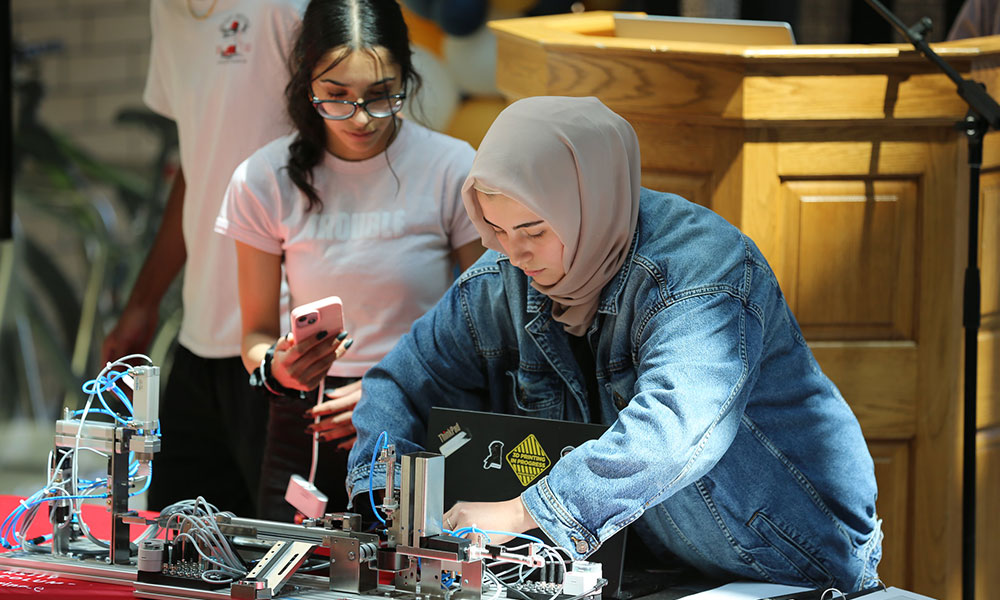
A photo of two KSS students working on an electrical engineering project.

Reema Abdullah and students from a Kelowna Secondary School Engineering 12 class demonstrate their mechatronics project at UBCO.

A unique partnership between UBC Okanagan’s School of Engineering and Kelowna Secondary School (KSS) is helping students in Grades 11 and 12 kickstart their engineering education. The course, Engineering 11/12, led by KSS teacher Jim Strachan, sees UBC faculty and graduate students visiting KSS or hosting KSS students at UBCO to discuss an array of topics across civil, mechanical, electrical and manufacturing engineering. This year, 17 students participated in the course. They went to UBCO to showcase their projects and toured the university’s engineering labs during a symposium to celebrate the program’s completion. “As an educator, it’s very rewarding seeing students develop an interest in engineering, connect with professors and be inspired to come to UBC Okanagan,” says Strachan. “Some of the students who have pursued an engineering education originally had no interest in the topic. It’s wonderful to see how this partnership opens students’ eyes to the opportunities. It inspires them and shows them they can do it.” Students explore topics like construction materials, building structures, sustainable infrastructure, sensors and radars, solar power, SolidWorks (computer-assisted design), fluids and thermodynamics, water quality and treatment, renewable energy systems, mechanical heart valves, engineering ethics and more. Among the 17 students who participated this year was Reema Abdullah, who graduated from KSS this month and will start at UBCO’s School of Engineering this fall. “I loved the practical, hands-on nature of the course,” explains Abdullah, who has enrolled in the Bachelor of Applied Science and Master of Management dual degree program. “We built concrete boats and learned the science and processes behind so many of the things in our world that engineers study, build and improve.” Abdullah says lessons on mechatronics sparked an interest in both electrical and mechanical engineering. “Between the supportive, inspiring faculty and the course content, I knew this was the path for me. I’m very excited to start my studies at UBCO this fall. My advice to any student thinking about taking this course would be not to be afraid. Step out of your comfort zone. Try it, and see if this field is for you.” That message is echoed by Dr. Claire Yan, Coordinator of the program and Professor of Teaching in Mechanical Engineering at UBCO’s School of Engineering. “The School of Engineering is always looking for ways to inspire students to step into the classroom or the lab and just get a sense of what the pathways are,” says Yan. “Whether or not students pursue an engineering degree, they will come away with some invaluable problem-solving and teamwork skills—and a desire to better understand the world around them. This will serve them well as engineers or whatever field of study they choose.” View a photo gallery of the engineering symposium at UBCO at: flickr.com/photos/200160808@N07/albums/72177720317888014. The post KSS and UBCO help engineer brighter futures appeared first on UBC Okanagan News.

A photo of the decorative stone entrance to the UBCO campus.

A group of UBC Okanagan School of Engineering students are fundraising to reach the World Conference on Earthquake Engineering in Milan, Italy, this summer.

A dedicated group of engineering students at UBC Okanagan is willing to move heaven and earth to reach the World Conference on Earthquake Engineering in Italy this summer.

The students belong to UBCO’s Advanced Structural Simulation and Experimental Testing Group (ASSET) in the School of Engineering, which is guided by Associate Professor Dr. Lisa Tobber. They’re eager to present alongside Dr. Tobber in Milan, but need financial support to do so.

“ASSET is looking to challenge and expand the current understanding of earthquake engineering,” says Mahya Moghadasi, a graduate research assistant. “Each contribution to the journey is more than just financial support; it invests in safer, more resilient communities worldwide.”

It’s also a personal journey for Moghadasi, who experienced a 6.3 Richter earthquake as a high school student growing up in Iran. Like her classmates, she arrived at UBCO to further her understanding of how we can make buildings safer during natural disasters.

“That moment was a turning point,” she says. “The earthquake was a terrifying experience. The ground shaking left me feeling afraid and vulnerable. As we evacuated our apartment, I recall vividly questioning the structural integrity of the buildings around me amid the uncertainty of the situation.”

Nations in the region from Turkey to Iran straddle significant tectonic plate boundaries and have experienced some of the most devastating earthquakes in human history; however, ASSET’s research projects are widely applicable and can inform disaster resiliency and modern construction policy from Vancouver to Venice.

Vancouver, for example, rests near the Cascadian Subduction Zone and is especially susceptible to earthquakes.

The conference is a vital opportunity for ASSET to share its innovative approaches with the international engineering community. ASSET aims to convene a session at the Milan conference about cost-effective resiliency solutions in reinforced concrete structures.

Dr. Tobber is convening a technical session at the conference with a focus on recent advances in cost-effective resiliency solutions for earthquake engineering. She’s to cover economic and sustainability considerations of innovative techniques for seismic resilience.

The session would allow ASSET to demonstrate how seismic safety can be achieved more affordably, Moghadasi says. As the conference date approaches, the group’s participation hinges on the support of donors and sponsors.

“Attending this conference is crucial for us to exchange ideas with the world’s leading experts and bring back knowledge that can benefit British Columbians.”

Learn more about the students at crowdfundraising.ubc.ca/projects/ubco-asset.

The post Engineering students building toward earthquake summit appeared first on UBC Okanagan News.

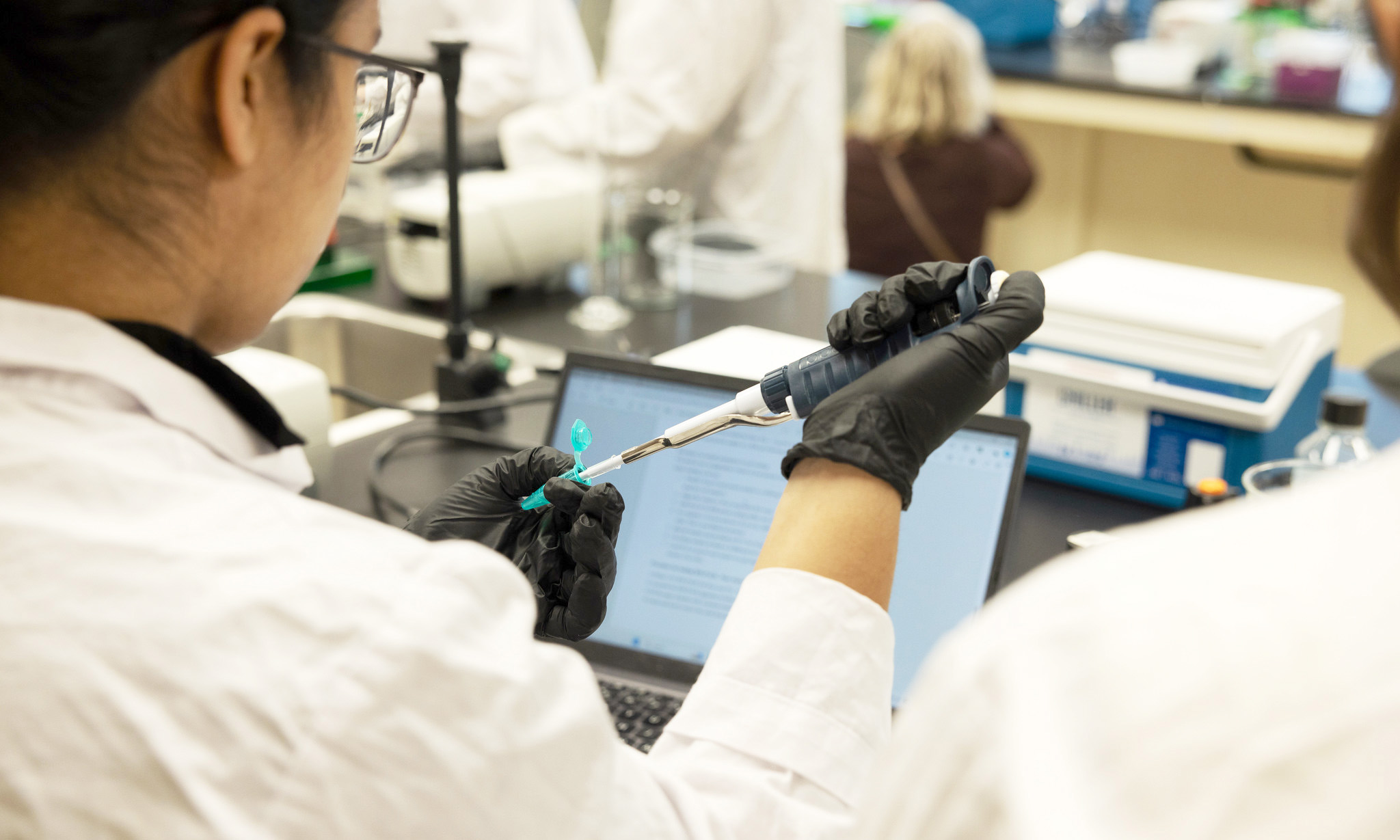
Students in lab coats and protective glasses, wearing latex gloves, perform science experiments using test tubes and pipettes.

High school students have until May 17 to register for UBC Okanagan’s SEED program.

UBC Okanagan engineering student Gurnoor Chawla knew she’d chosen the right educational path after an inspiring summer learning experience at the university while in high school.

Chawla is now a third-year Electrical Engineering student in UBCO’s School of Engineering (SoE), and she encourages the next cohort of high school students to follow in her footsteps and register for the Stewards in Engineering Education (SEED) Program this July.

“I’d been looking into engineering as a potential career,” Chawla says. “I enjoyed how realistic and hands-on it was. Connecting closely with professors and graduate students helped me learn skills and understand research in the field.”

Participants join in cutting-edge research projects with world-class researchers and graduate students in state-of-the-art facilities, all under the supervision of SoE hosts.

The free program is designed to be a springboard for students planning their education. Chawla is now a student ambassador for the SoE and speaks highly of the SEED Program.

She says stepping into the radioactive materials lab, seeing the electron microscope and interacting with the radioactive materials lab were among the most memorable moments of her SEED experience.

She especially enjoyed the intensity and the collaborative spirit between the students and says that helped validate her decision to study engineering at UBCO.

“Overall, the SEED program provides a very realistic and intensive understanding of work in university research labs,” she says. “It ensures you’re putting effort into the work instead of simply watching from the sidelines. Anyone interested in engineering should come in with an open mind and a will to explore because this is an amazing opportunity and a great way to create a strong network at UBCO.”

Dr. Jonathan Holzman, an Electrical Engineering Professor and SEED faculty lead, says the program offers students a unique, hands-on opportunity.

“Many incoming students will have never seen—let alone actively experienced—a research lab before. SEED can help them better understand the research environment and the many engineering pathways as they make their post-secondary choices,” he says.

This year’s SEED program runs from July 22 to 26. Applications are open until May 17 and can be completed online.

To learn more about the program, visit engineering.ok.ubc.ca/programs-admissions/outreach-programs

The post UBCO’s School of Engineering seeks to inspire the next generation appeared first on UBC Okanagan News.

A photo of an elderly man receiving health care in his home.

UBC Okanagan’s Dr. Amir Ardestani-Jaafari used strategic approaches to research how health-care providers can create robust yet flexible home-care networks to meet future demands.

For Canadians who want to age at home as long as possible, a team of UBC Okanagan researchers is studying how to organize home-care networks to ensure they receive the care they need in the most efficient manner possible.

Led by Master of Science student Pooya Pourrezaie, a team from UBCO’s Faculty of Management and School of Engineering collaborated on the study to examine how to remove some of the unknowns.

“Planning for the future is a challenge for those tasked with ensuring our health-care system can meet our needs as we age,” Pourrezaie says. “Our research doesn’t claim to have all the answers, but it offers a new way to think about and prepare for the future, ensuring Canadians can receive the care they need in their homes, for as long as possible.”

The study focuses on a strategic model that optimizes the placement of home-based health-care facilities. This model is designed to navigate the uncertainties surrounding demand for solutions that are robust yet flexible. By balancing the need for widespread accessibility with the practicalities of health delivery, the team’s work promises to help policy-makers and health-care providers make informed decisions, even when faced with limited information.

“Our findings strike a balance between the need for careful planning and the reality of fluctuating demand,” Pourrezaie says. “We’re showing that it’s possible to plan effectively for home health care, reducing unnecessary expenditures and maximizing the impact of every dollar spent.”

To reach their findings, they relied on strategic testing. They created simulations—virtual experiments—to test their ideas on how to best place home health-care facilities in locations that could benefit the most people in the most economical way feasible.

Then they’d test those networks. They used mathematical models to imagine different scenarios, including how many people might need care and where.

“It connects our academic research with real-world problems,” Pourrezaie said. “It provides a starting point for more responsive and sustainable health-care planning, which we know is so important to Canadians.”

This research is more than just an academic exercise; it’s a blueprint for the future of home care in Canada. As the population ages, the demand for such services can only increase. The insights from this study provide a pathway for delivering care that is both patient-focused and sustainable.

It’s a reminder that with thoughtful research and innovative thinking, we can prepare for the future of health care in a way that keeps Canadians in their homes longer, healthier and happier, Pourrezaie says.

“For Canadians who value their independence, this study is a step towards ensuring that the health-care system will be there to support them, in their homes, for many years to come,” he says.

Pourrezaie worked under the guidance of the Faculty of Management’s Dr. Amir Ardestani-Jaafari and the School of Engineering’s Dr. Babak Tosarkani.

The research appears in the journal INFOR: Information Systems and Operational Research. The Natural Sciences and Engineering Research Council of Canada supported this research.

The post People want to age at home, UBC Okanagan can help them stay healthy appeared first on UBC Okanagan News.

A photo of air intake fans of a building.

UBCO research shows that airflow dynamics can reduce pathogens by 85 per cent in a classroom setting.

If you’ve ever wondered why some folks never catch the office or school cold, where they’re sitting might be keeping them from the path of pathogens according to new UBC Okanagan research.

Using a working UBCO classroom as their test lab, the team found that accounting for the airflow dynamics reduced the pathogens by 85 per cent.

“During the COVID-19 pandemic, the advice was often just to increase ventilation to the maximum,” says Mojtaba Zabihi, a doctoral student in mechanical engineering and a lead researcher in the UBC Airborne Disease Transmission Research Cluster.

“But the new findings show that understanding the airflow pattern is as important, as the amount of air change per hour. This insight could potentially lead to safer buildings and significant energy savings.”

The study measured and analyzed airflow in a working UBCO classroom to understand its influence on pathogen dispersion. Considering what might be in the room to affect how the air flows—desk arrangement or vent placement, for example—and how we design building ventilation systems could help improve standards and improve indoor air quality, Zabihi says.

“Our research demonstrates that an under-floor air distribution concept combined with the ceiling-distributed exhaust system, which generates local and vertically stretched airflow patterns, can significantly reduce airborne pathogens in classrooms by up to 85 per cent,” he says.

“If building ventilation systems are designed with disease prevention in mind, it could be a critical tool in maintaining our health.”

The research findings, chosen by the editors of the journal Building Simulation for their March cover story, offer promising directions for the design and operation of indoor spaces. Yet, while the study’s implications suggest a new avenue for enhancing public health through building design, Zabihi carefully positions their work within a broader context.

“Our research adds an important layer to understanding how we might better protect indoor environments. It’s a step toward cleaner spaces, a complementary strategy alongside existing health measures,” he says.

Zabihi conducted the work under the guidance of UBCO’s Drs. Sunny Li and Joshua Brinkerhoff, whose expertise in mechanical engineering and fluid dynamics provided a foundation for the project. As the results gain traction, Zabihi said the team is hopeful about the research’s influence.

“Our goal was always to contribute meaningfully to the conversation on public health and indoor air quality. This publication marks an important milestone in our journey,” Zabihi concludes.

“It feels like being on the front lines, making a real difference. It’s not just theoretical; we can see how our findings could significantly affect public health and everyday life.”

The post Research breathes fresh air into classrooms at UBC Okanagan appeared first on UBC Okanagan News.