Harrison Crerar

Email: haryc123@mail.ubc.ca


In the spring of 2024, Megan Smith, MDes Director, and Philip Wyness, FCCS Technical Director, worked with a design team from VS America to design the new Design Studio for UBC’s Master of Design program. Below is an excerpt from the project profile, prepared by Thomas Doe, Director of Higher Education for VS America.

Design Studio, Masters of Design program, UBCO

Photo credit: Andrew Lowes

Project Profile: Critical Future Studio Lab and Master of Design Studio

When we met the Director of UBC Okanagan’s Master’s in Design program, Dr. Megan Smith, and Technical Director, Philip Wyness, they were working towards creating a multidimensional space that would serve a variety of needs within a relatively small footprint. The space offers several unique features, including cutting-edge visualization technologies, dedicated collaborative areas equipped with state-of-the-art prototyping tools and materials, and areas where partnerships can be established with industry leaders for real-world projects. Additionally, the space fosters interdisciplinary collaboration by integrating expertise from the School of Engineering, the Faculty of Creative and Critical Studies, and the Faculty of Arts and Social Sciences. It became clear that a thorough understanding of how people come together, while being supported ergonomically, was key to a successful project outcome.

The final design of the space offers several unique features. In the main atrium, we used the large-scale, writable Fliptable-TQ, which can be rearranged and grouped together to support collaboration and the offloading of ideas as students work to plan projects. The JUMPER® Air Four provides a lightweight, stacking chair that has a durable enough construction to stand up to the hands-on exploration that will take place in this space. Ergonomic stacking Solo stools, with a variety of footrest heights, allow users to adopt different sitting positions and provides overflow seating. High-density SPACE storage organizes everything needed for the program, such as tools, markers, and VR goggles for simulation work.

Design Studio, Masters of Design program, UBCO

Near the private and shared offices, we incorporated the same nesting tables as the atrium, as well as mobile, pneumatic height-adjustable RondoLift workstations that can be easily moved in and out of the offices to promote collaboration between faculty and students. Outdoor friendly plastic rocking chairs near a living garden provide a moment for casual conversation and the opportunity to enjoy the benefits of some plant life within the space or moved outside via the garage door.

One project from the Critical Future Studio Lab and Master of Design Studio that has created ripples is All the Stars We Cannot See by Dr. Megan Smith and Dr. Gao Yujie. This immersive and interactive installation situates participants within a virtual sky activated by 25,500+ satellites orbiting Earth. The artists worked to render a visible representation of the global impact of satellite density. This artwork builds a space for discussion on the impact of space colonization and brings awareness to growing mechanisms of surveillance and the political and economic driving forces for occupying space. It won an Honorary Mention at Ars Electronica in 2022 and was exhibited at Kelowna Art Gallery (October 2023 – March 2024) and York University (Fall 2024).

Another project is by Bahman Fakouri, a master’s student in the IGS program, Digital Arts & Humanities theme, Experiencing Kelowna Wildfire. This project is an immersive, narrative-driven VR experience that provides an intimate perspective on the far-reaching consequences of environmental crises.

We are proud to have been a partner in Dr. Smith’s Canada Foundation for Innovation’s Critical Future Studio Lab, which aims to inspire the next generation of design leaders and entrepreneurs through its flexible layout, cutting-edge technology, and emphasis on sustainability and social responsibility.

 “The space aims to inspire the next generation of design leaders and entrepreneurs through it’s flexible layout, cutting-edge technology, and emphasis on sustainability and social responsibility.”

– Dr. Megan L. Smith , Associate Professor in Creative Technology & Director Master of Design


All the Starts We Cannot See projected in the Critical Futures Studio performance space

All the Starts We Cannot See projected in the Critical Futures Studio performance space

Bahman Fakouri's standing in front of his VR project, Experiencing Kelowna Wildfire

Bahman Fakouri’s standing in front of his VR project, Experiencing Kelowna Wildfire

Chris Bingham from Cyan Bold Design.

Chris Bingham from Cyan Bold Design.

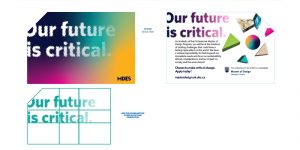
The Masters of Design (MDes) program got a new look this spring. MDes Director, Megan Smith, and Communications Strategist, Shauna Oddleifson, worked with local designer Chris Bingham from Cyan Bold Design to create a new visual identity for the program.

Chris Bingham, CDPTM, is the graphic designer responsible for Cyan Bold Design in Kelowna, BC. He started his career in design as an educator, then moved on to agency work and in-house design before establishing his own gig. Specializing in brand identity and logo design, he has worked with clients across various industries, from school divisions to social enterprises and machinery to marmalade. However, nothing pleases him more than being able to break out all of the colours in the crayon box and use them in a design project.

Beyond design, Chris works as a brand strategist and consultant, a role that involves bridging the gap between marketing and design. As a brand strategist, he helps his clients define their brand’s unique value proposition, target audience, and competitive positioning. He then advises them on how to express these elements through their brand assets, such as campaign materials, stationery, social media, packaging, stage scrims, tradeshow materials, banners, billboards, print ads, online ads, brochures, signage, stickers, apparel, swag, posters, and more.

Chris firmly believes in the transformative power of graphic design to shape perceptions and unite communities. He has demonstrated this belief through initiatives like Design Day for GOOD, which he organized to amplify the visual presence of nonprofit organizations in Kelowna. His collaboration with You Are Collective on Pride apparel collections supporting Etcetera Youth Group is another testament to his commitment to using design for positive change.

His motto is to BE BOLDER BY DESIGN, and he puts that to work in everything he does.

“One of the goals of the MDes is to build partnerships in the community, and working directly with the design community in Kelowna was a great way for us to start to make those connections,” explains Megan Smith. “Working with Chris to come up with this new look and feel for our program really helps to synthetize our messaging, and we are thrilled with the work that was done.”

This new visual identity can be seen throughout this web site, in our digital marketing, and will soon show up on new tote bags, t-shirts and other items for giveaways.

Here are some examples of the design elements used in creating the assets for the program marketing:

Transformative data visualizations

Business card and postcard Designs

Dr. Megan Smith with colleague Dr. Yujie Gao work on a VR project.

Dr. Megan Smith with colleague Dr. Yujie Gao work on a VR project.

The newly formed Master of Design degree at UBC Okanagan is a first for professional master’s degrees in Canada, and it’s now accepting applications.

UBCO’s Faculty of Creative and Critical Studies, School of Engineering and Irving K. Barber Faculty of Arts and Social Sciences created the interdisciplinary program to help answer vital questions affecting the planet.

“We are excited that we can work on designing solutions to wicked problems in British Columbia and beyond,” Program Director Megan Smith says. “The program blends critical engineering, art and design disciplines to get hands-on and dig deep into resolving issues while training in entrepreneurship.”

The Master of Design degree is a full-time, 12-month professional graduate-level program intended to help students build design solutions for global challenges. The program blends critical design thinking, creative practice and engineering principles within a culture of innovation, creativity and social and sustainable entrepreneurship.

Courses focus on community-based creative approaches to project design as well as the conceptualization and preparation for prototyping and presentation of projects. The program is experiential by design, and students will learn through workshops, seminars, lectures, hands-on experiences, studio time and ongoing mentorship.

“There is a growing trend that challenges are becoming more complicated, and the solutions for these challenges need to be more creative and innovative,” explains Assistant Professor of Engineering Alon Eisenstein, who teaches in the program.

“It allows professionals from the arts, communications, engineering and tech communities to collaborate as a cohort in an interdisciplinary project-focused program that creates solutions for society, both local and global.”

Smith notes that the research tackles big questions and problems. “I design immersive experiences that allow the public to experience satellite data and infrastructure in new ways. I have worked on exposing human elements within large computational infrastructures and have designed virtual reality hardware for public safety training,” she says.

“I believe that by working across art, engineering and computer science, we can discover new solutions to major problems affecting the world. In particular, we need to rapidly develop solutions to mitigate the impact of climate change. We have to play a role in that effort.”

During the program, students will develop a project by onboarding an extensive resource of applicable skills, learning from experts and receiving first-hand experience and feedback on their work as they progress through production cycles.

The need for human-centred design and having the user at the centre of the process using design principles is becoming more in demand. Eisenstein adds that collaboratively solving problems in a team and finding solutions through working with other disciplines expands understanding and fuels growth.

“This concept of working together across disciplines is the real value and the core benefit of this program,” he says.

The first cohort is to begin study in May 2024. Interested applicants can email masterdesign.ok@ubc.ca to receive updates on the program.

For more information about the MDEs program, visit masterdesign.ok.ubc.ca.

WHEN DR. PEYMAN YOUSEFI REFLECTS on what’s shaped his academic journey, he thinks of the rapidly evolving technology that grew exponentially throughout his life and career and the new and exciting opportunities it offers to transform education. He says embracing forward-thinking approaches empowers students to become agile problem-solvers and lifelong learners in a swiftly changing world. “Rapid change can make it difficult to adjust, but cultivating a growth mindset and prioritizing ongoing education can help individuals stay competitive and uncover new opportunities,” he says. His mother, a vocational training instructor, encouraged him to find joy in lifting others. “My mother always supported her students and worked collaboratively with them.” His first experience with teaching came as an undergraduate when he helped classmates understand complex concepts. Dr. Yousefi’s commitment to helping others is one of many reasons he was recognized with a 2023 UBC Okanagan Provost’s Award for Teaching Excellence and Innovation—and this isn’t his first teaching award. His deep passion for teaching was recognized even as a graduate student at UBCO when he received the Provost’s Award for Teaching Assistants and Tutors. While his mother influenced his love of teaching, a passion for sustainability inspired Dr. Yousefi to pursue engineering. After graduating with his doctorate, he moved quickly into a teaching role but remains deeply involved in his field through mentorship. His research contributions focus on modelling and simulating complex hydrological processes, predicting water availability and quality, as well as supporting decision-making for water management.
Peyman Yousefi using a VR headset.

Dr. Peyman Yousefi.

Dr. Yousefi incorporates real-world engineering projects into his curriculum to enable students to apply their theoretical knowledge to practical situations. He also invites professionals from related fields as guest speakers, allowing students to learn about different aspects of the industry and career opportunities. “My main responsibility is to help graduates earn experience,” he says. “Educators should support their students to find what they are passionate about, even former students who have graduated and need mentorship to build their careers.” Involving students in transforming his courses and teaching methods has proven invaluable to Dr. Yousefi. By establishing advisory boards, students meet with him regularly to discuss concerns, provide feedback on teaching methods and offer suggestions for improvement. “I want students to feel their voices are heard. Their insights have been a powerful tool in creating a welcoming and inclusive learning environment.” He brings those ideas with him into the classroom. He puts thought into how he teaches. He embraces technology because his students embrace it, and he isn’t afraid to use new tools and feedback to redesign course content or his teaching methods. Exploring new technologies in the classroom—such as virtual reality and simulation tools or adaptive learning platforms—allows him to customize the learning experience. Exploring assessment techniques that accommodate diverse learning styles was part of his International Scholarship of Educational Leadership program project, completed in 2022. “I feel proud when I help students successfully learn difficult concepts. It’s a gratifying moment, making me love my job even more.” The post Reimagining education through innovative approaches appeared first on UBC Okanagan News.

The post Mastering Blockchain appeared first on UBC's Okanagan News.

The post Engineering Nanotech appeared first on UBC's Okanagan News.

The post The Reality of Sci-fi appeared first on UBC's Okanagan News.

The post Sustainable Cities appeared first on UBC's Okanagan News.

The post Space to Innovate appeared first on UBC's Okanagan News.

The post Empowering Entrepreneurs appeared first on UBC's Okanagan News.