
David Bidwell

Email: david-bidwell@news.ok.ubc.ca


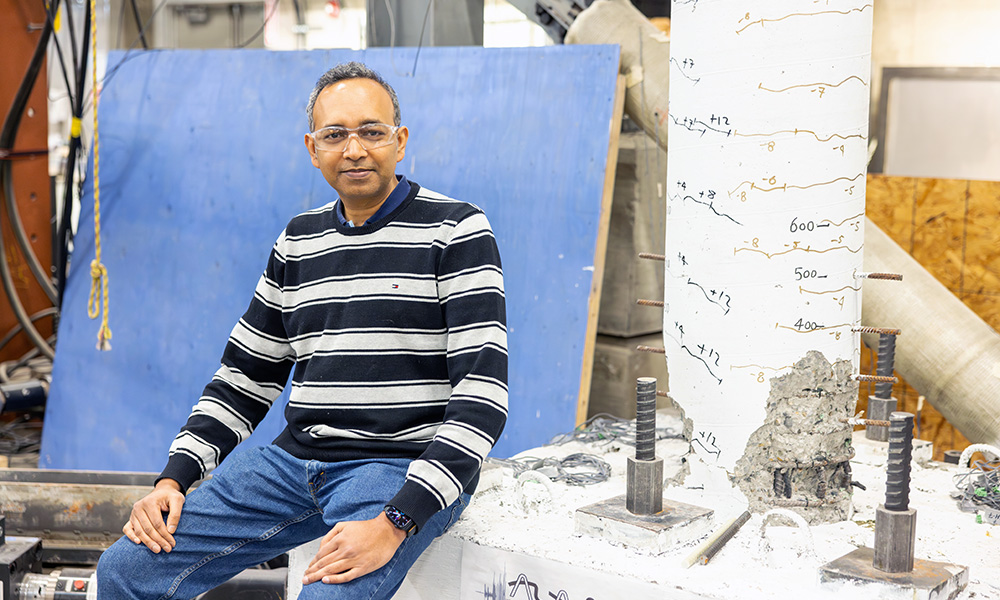
A photo of Dr. Shahria Alam in front of a concrete pillar that has been strength tested and shows lots of wear and tear.

Dr. Shahria Alam conducts research in the seismic analysis and rehabilitation of steel, concrete and masonry. His latest research examines variations in the strength and mechanical properties of rebar to determine if the product meets Canadian safety standards.

A truck, along with hundreds of other vehicles filled with drivers and passengers, rumbles over the Alex Fraser Bridge.

The drivers probably never give a second thought to what is holding up that bridge—what makes it safe. Below, and embedded into the bridge deck and piers, are tens of thousands of pounds of steel rebar. The rebar, a skeleton integrated within the concrete, provides strength to the structure and reinforces the bridge’s seismic integrity.

But how do engineers know how much rebar to use? Should it be thicker? Stronger? Is the bridge protected in case of an earthquake?

“During a seismic event, the rebar serves two purposes,” says Dr. Shahria Alam, Civil Engineering Professor at UBC Okanagan’s School of Engineering. “It helps keep pieces intact during small earthquakes and it ensures safety while sustaining damage during major earthquakes.”

Rebar comes in a variety of configurations based on strength, ductility, length and diameter, he explains. The challenge engineers face is the uncertainties associated with the materials used to make structural designs safe, efficient and predictable.

Concrete, reinforced with rebar, plays a vital role in providing resistance, but variations in the rebar’s mechanical properties can increase uncertainty in the assessment of existing structures and the design of new structures. The production of steel rebar involves several steps, including purifying, alloying, rolling and temperature treatment, which could have an impact on its mechanical properties.

Factors that can affect rebar’s strength include the microalloying stage—when elements such as carbon and manganese are added to the steel to make it stronger—as well as the source of the mill.

“The mechanical properties of steel rebar are reliant on the manufacturing processes within any given mill,” says Dr. Alam. “In this scenario, it’s not only the size but also the tensile strength and the material’s ability to withstand repeated stress and deformation that matters.”

Dr. Alam explains that the Canadian Standards Association sets out requirements in the bridge design code to ensure that all rebar performs predictably. His team of researchers at UBCO’s Applied Lab for Advanced Materials & Structures recently completed a study examining different types of rebar to see if it was indeed meeting North American design standards.

The researchers examined tensile test data, provided by the Concrete Reinforcing Steel Institute to investigate the variability of mechanical properties across a few parameters including mill source, bar size and weight per metre.

The data was also compared to the minimum requirements of the American Society for Testing and Materials (ASTM)

“Our most recent research sought to investigate the recent variability of mechanical properties, specifically the yield and ultimate tensile strength of steel rebars in North America.”

Their study showed that only a fraction (0.12%) of the strength test results didn’t meet the basic safety standards. This means that if buildings are designed according to the official codes and with extra safety margins built in, the structures will be sufficiently safe.

The research is supported by the Natural Sciences and Engineering Research Council of Canada, the British Columbia Ministry of Transportation and Infrastructure and the engineering consulting firm WSP Canada through an Alliance grant. It was published in the latest edition of the journal Engineering Structures.

The post When it comes to rebar, stronger doesn’t mean better appeared first on UBC Okanagan News.

A photo of a person using mobile phone near a 5G communications tower.

UBCO and Drexel University researchers have developed state-of-the-art communication components that have a compatible performance to metal, but are 10 to 20 times lighter, less expensive and easy to build.

In a first-of-its-kind development, UBC Okanagan researchers, in collaboration with Drexel University, have created a new compound that can be used to 3D print telecommunication antennas and other connectivity devices.

These 3D printed products, created by combining a two-dimensional compound called MXenes with a polymer, can be used as an alternative for metallic counterparts and can make a vast improvement in communication technology including elements such as antennas, waveguides and filters.

Waveguides are everywhere, yet most people don’t know what they are, says Dr. Mohammad Zarifi, a researcher in UBC Okanagan’s Microelectronics and Gigahertz Applications (OMEGA) Lab.

Waveguides are structures or pipes that help direct sound and optical waves in communication devices and consumer appliances like microwaves. Waveguides vary in size, but historically they are made of metal due to their conductive attributes.

Dr. Zarifi and his OMEGA team develop state-of-the-art communication components that have a compatible performance to metal, but are 10 to 20 times lighter, less expensive and easy to build.

“In the ever-evolving landscape of technology, waveguides—a foundation in devices we use daily—are undergoing a transformative shift,” explains Dr. Zarifi, an Associate Professor with the School of Engineering. “From the familiar hum of microwave ovens to the vast reach of satellite communication, these integral components have traditionally been made from metals like silver, brass and copper.”

MXenes are an emerging family of two-dimensional materials—with the titanium carbide MXene being a leader in terms of electrical conductivity, explains Dr. Yury Gogotsi, Director of the A.J. Drexel Nanomaterials Institute at Drexel University in Philadelphia

“Think of MXenes as nanometre-thin conductive flakes that can be dispersed in water-like clay,” Dr. Gogotsi says “This is a material that can be applied from dispersion in pure water with no additives to almost any surface. After drying in air, it can make polymer surfaces conductive. It’s like metallization at room temperature, without melting or evaporating a metal, without vacuum or temperature.”

Integration of MXenes onto 3D-printed nylon-based parts allows a channel-like structure to become more efficient in guiding microwaves to frequency bands. This capability in a lightweight, additively manufactured component can impact the design and manufacturing of electronic communication devices in the aerospace and satellite industry, explains Omid Niksan, a UBCO School of Engineering doctoral student and first author of the article.

“Whether in space-based communication devices or medical imaging equipment like MRI machines, these lightweight MXene-coated polymeric structures have the potential to replace traditional manufacturing methods such as metal machining for creating channel structures,” he adds.

The researchers have a provisional patent on the polymer-based MXene-coated communication components. And Dr. Zarifi notes the potential of this equipment is sky-high.

“While there is still additional research to be done, we’re excited about the potential of this innovative material.,” says Dr. Zafiri. “We aim to explore and develop the possibilities of 3D printed antennas and communication devices in space. By reducing payloads of shuttle transporters, it gives engineers more options.”

The research was conducted in collaboration with scientists from Drexel University’s A.J. Drexel Nanomaterials Institute and supported by  the Department of National Defence, the Natural Sciences and Engineering Research Council and the United States National Science Foundation. It was published in the latest edition of the journal Materials Today.

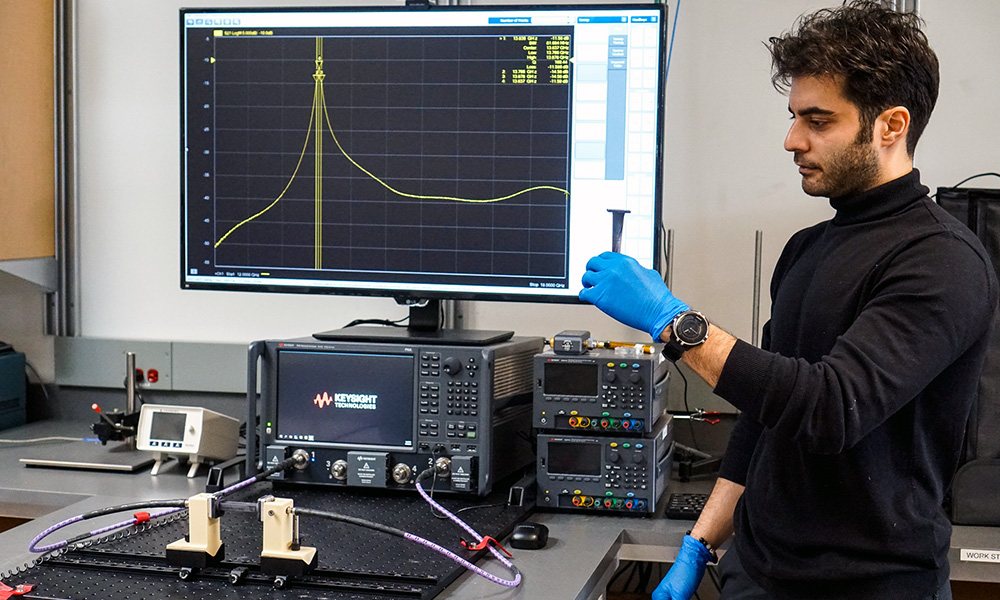
Omid Niksan is holding up a prototype of a 3D-printed twisted channel structed.

Omid Niksan holds a prototype of a 3D-printed MXene-coated component that can be used as an alternative for metallic components in antennas, waveguides and filters.

The post UBCO researchers create new compound to build space-age antennas appeared first on UBC Okanagan News.

A photo of two students talking in front of a rammed earth wall.

Rammed earth technology, where waste products such as fly ash, are used as sustainable building materials can also be used to make decorative feature walls like this one at UBC Okanagan.

Researchers at UBC Okanagan are revisiting old building practices—the use of by-products and cast-offs—as a way to improve building materials and sustainability of the trade.

A technique known as rammed earth construction uses materials that are alternatives to cement and are often more readily available in the environment. One such alternative is wood fly ash, a by-product of pulp mills and coal-fired power plants, explains Dr. Sumi Siddiqua, with UBC Okanagan’s School of Engineering.

Industry has been trying to find a use for materials like fly ash that predominantly end up in landfills, she explains. Better described as a fine powder, fly ash shares the same strength and texture characteristics as cement, which is often added to concrete to enhance its strength.

“There are many benefits to using this material,” explains Dr. Siddiqua, Civil Engineering Professor and lead researcher with UBC’s Advanced Geomaterials Testing Lab. “Using local soil along with rammed earth products reduces sand exploitation. And just as importantly, this material is not affected by wildfires to the same extent as current wooden structures.”

Together with BC Housing, UBC’s Build Better Cluster is partnering with Indigenous communities to integrate rammed earth into the construction of new homes. With international shortages in construction sand—which is much different than sand found in beaches—builders are searching for cheap, and readily available materials that are equally as strong, for next-generation cement.

“Everything old is new again and that is precisely why we’ve been investigating rammed earth construction,” says Dr. Siddiqua. “By integrating industrial by-products, we’re addressing an increasing need for readily available building materials and being sustainable in the process.”

Under most circumstances, test results show fly ash enhances the structure’s properties and makes it suitable for use in cold and hot climates as load-bearing, non-load-bearing and isolation panel walls. Fly ash also has the added benefit of being available in remote communities while providing increased insulation properties.

Although Dr. Siddiqua doesn’t foresee a huge uptick in rammed earth homes and buildings sprouting up in the short term, the addition of materials like fly ash into composite cements has already begun. And she suggests, it might be the way of the future when it comes to the building trades.

“There is an increasing demand for sustainable building products here in Canada and around the world, and materials like fly ash are just the start of a new and important trend.”

The research was supported by a Natural Science and Engineering Research Council of Canada Discovery and Engage grant. It was published in the latest edition of the Journal Construction and Building Materials.

The post UBCO researchers look to the past to improve construction sustainability appeared first on UBC Okanagan News.