Meet Engineers in Action Okanagan (EIA Okanagan), a student-led engineering design team that partners with underserved communities around the world to design and construct sustainable infrastructure solutions. Founded in 2024, the team empowers students to apply classroom concepts in real-world, cross-cultural settings while encouraging and developing leadership, communication, and project management skills. As part of the global EIA program, EIA Okanagan connects students with industry professionals for mentoring, as well as other university chapters to create community-driven infrastructure.

Members of the club standing on top of the bridge they built
Tell us about your team?
EIA Okanagan is a multidisciplinary club composed of engineering and management students focused on humanitarian infrastructure projects. The club operates under three core groups: Project Management, Bridge, and WASH (Water, Sanitation, and Hygiene), each collaborating closely with faculty advisors, alumni, and industry mentors.
The Bridge team designs pedestrian bridges for rural communities, transforming site layouts into fully engineered, buildable structures over the course of a year. The WASH team is a new addition that focuses on water and sanitation projects. Meanwhile, the Project Management team coordinates logistical work such as stakeholder communication, fundraising, budgeting, events, and day-to-day operations to keep the club running smoothly.
Together, these groups form a cohesive unit that not only designs and constructs life-changing infrastructure but also offers students hands-on professional experience in teamwork, leadership, and sustainable design.
How did your team get started or grow over time?
EIA Okanagan began in late 2023 when a small group of students recognized a gap on campus for a club that applied engineering skills to real-world humanitarian challenges. What started as an idea quickly evolved into a formal club by early 2024.
Initially, the team planned to operate as a tag-along chapter, supporting experienced universities in an observational capacity. However, student dedication soon exceeded expectations. Within their first year, members successfully designed and helped construct the Chunchuli Alto bridge in Bolivia while working alongside chapters from the University of Alberta and the University of Toronto.
That project marked the club’s first tangible success, serving as proof of concept. The completed bridge now connects more than 1,500 community members to schools, markets, and clinics. Building on that success, the team was invited to lead EIA’s first student-led bridge in Peru and collaborate on a new WASH initiative in Bolivia in partnership with CU Boulder and Washington State University.
From just four founding members to more than fifty today, the club has grown rapidly and continues building the foundation for future members to carry forward.
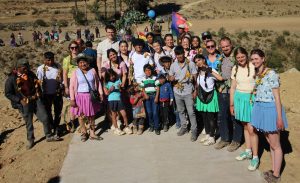
The students standing in front of the bridge with the residents.
What has been one of your team’s proudest accomplishments so far?
The club’s proudest moment was the “Entrega”, or inauguration ceremony, of the Chunchuli Alto bridge. Two UBCO students, Erik and Teryl traveled to Bolivia and lived within the local community for a month while helping construct the bridge.
They described the experience as life changing and a true test of engineering and adaptability. They worked ten-hour days, six days a week, performing manual labor in remote conditions with limited access to electricity and water. Despite the challenges, they formed strong bonds with community members and celebrated their success together at the bridge’s opening, where local elders inaugurated the structure with dancing and music.
This moment reinforced the purpose behind EIA Okanagan: Using engineering to create meaningful, tangible change.
“Using engineering to build meaningful tangible changes”
How has being part of the design team shaped your view and understanding of
engineering?
Being part of EIA Okanagan has shown members that engineering goes far beyond technical design. It includes collaboration, empathy, and global impact. Through hands-on experience, students have learned to apply classroom knowledge in unfamiliar, resource-limited environments and to think critically about how their work affects the daily lives of community members.
The projects mirror real engineering practice. Multiple stakeholders, international coordination, safety requirements, and strict standards. Students learn to communicate across cultures and disciplines, gaining a level of perspective and responsibility that classroom projects cannot always provide.
What was a challenge you had as a team, and how did you overcome it?
As a new chapter, one of the biggest challenges was building legitimacy, establishing a sustainable internal structure, securing funding, and earning trust within the university framework. Unlike competition-based teams, EIA Okanagan’s model did not fit existing club systems.
Early on, the team relied on small grants, crowdfunding, and support from various student organizations. Over time, they developed a stronger foundation by forming corporate partnerships, establishing faculty mentorships, and creating succession plans to ensure long-term success.
Mentorship from EIA’s Bridge Corps and alumni advisors played an important role. Students learned that success came from working with, not against, existing systems by building relationships and showing value through impact.
How do you think student design teams contribute to the UBCO engineering experience overall?
Clubs like EIA Okanagan transform the UBCO engineering experience by bridging the gap between academic learning and real-world application. They challenge students to lead, problem-solve, and communicate across cultures and disciplines.
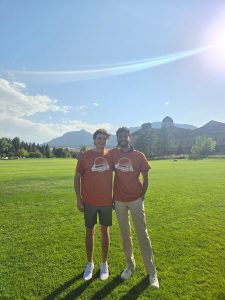
Two members of the club standing in a field
Beyond technical design work, students develop leadership, budgeting, risk management, and stakeholder communication skills that are essential in professional engineering environments. Through partnerships with alumni and EIA’s international network, members also gain access to mentorship and professional development opportunities that prepare them for co-op and future careers.
These experiences create engineers who are not only technically capable but also socially aware, globally minded, and ready to make a difference.
What was one of your team’s best memories while working together?
One of the club’s most meaningful memories was standing on the completed Chunchuli Alto bridge alongside the Bolivian community during the inauguration ceremony. Months of design work, safety reviews, and construction planning culminated in a single, powerful moment of connection.
Erik and Teryl described living with host families, attending a community wedding, and building lifelong friendships with locals. These experiences reminded them why they joined EIA Okanagan. To see engineering transform lives firsthand.
How does being part of the team prepare members for co-op positions or jobs post
graduation?
EIA Okanagan equips students with both technical expertise and professional competencies that translate directly to co-op placements and future careers. Members gain experience in structural design, load analysis, construction management, and safety planning. They also strengthen teamwork, leadership, budgeting, and cross-cultural communication skills.
Because every project involves coordination between multiple universities and industry mentors, students learn to manage complex stakeholder relationships similar to those found in real-world engineering projects. The projects are as global as they get and as down to earth as they come.
As a result, EIA Okanagan alumni enter the workforce with a strong foundation in both engineering practice and human-centered design.
“Our projects are as global as they get and as down to earth as they come.”
As a member of the team, what opportunities are available to connect with industry
professionals, alumni or companies?
Members engage with professionals through EIA’s Bridge Corps network, which connects students to practicing engineers and project managers across North America. Within UBCO, the club regularly hosts professional development events featuring alumni and industry partners who share insights on career paths, project management, and field engineering.
An upcoming alumni panel will feature graduates working in industry and government. Two in civil engineering, one in mechanical engineering, and one in management. These conversations provide mentorship and guidance to current members.
Corporate sponsors can also connect directly with the club by participating in speaker sessions, offering technical mentorship, or collaborating on outreach initiatives, strengthening ties between education and industry.
What are the technical and transferrable skill members typically develop by being part of
the team?
Members develop a balanced mix of technical and transferable skills that extend beyond the classroom. Technical skills include bridge design, load calculations, material selection, concrete mixing, and safety analysis.
Equally important are transferable skills such as project management, financial planning, communication, adaptability, leadership, and intercultural teamwork. Students also learn to work in resource-limited environments, an invaluable skill for any engineer entering the global workforce.
What advice would your team give to students thinking about joining or starting a design
team?
Start small, stay passionate, and focus on the impact you want to make. Building a club from the ground up takes time, patience, and collaboration, but every initiative begins with a few dedicated students and a clear purpose.
Seek mentorship early, establish a solid structure, and remember that growth comes from learning by doing. Most importantly, build a culture that values both technical excellence and human connection. The strongest engineering clubs do more than build structures. They build communities.
“Building a team from the ground up takes time, patience, and collaboration, but every great initiative starts with a few dedicated students and a clear purpose.”
Anything else you’d like to share?
EIA Okanagan is always looking for motivated students who want to combine their technical knowledge with real-world impact. Whether your interest lies in design, construction, management, or outreach, there is a place for you in EIA Okanagan and an opportunity to make a tangible difference in the lives of others.
The club is also seeking partners and sponsors who share their commitment to sustainable development and student growth. Join them in creating long-term positive change while connecting with a dynamic group of future engineers and leaders.
In addition, the team is continuing to raise funds through their ongoing student-led crowdfunding campaign, which directly supports travel, construction materials, and community-driven infrastructure projects. You can contribute here: Support the campaign
Curious about Engineers in Action Okanagan? Visit their LinkedIn: Learn more!